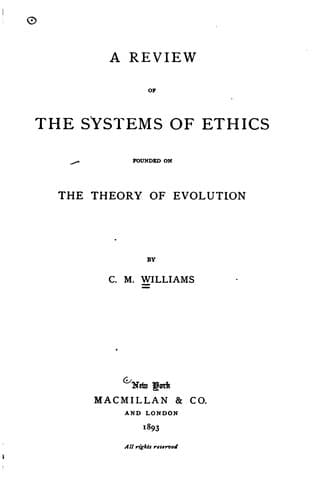
A Review of the Systems of Ethics Founded on the Theory of EvolutionWilliams, Cora May
Philosophy
A Review of the Systems of Ethics Founded on the Theory of Evolution
Williams, Cora May
Ethics, Evolutionary
For the Reason to which Love, Public Spirit, and Humanity are the
natural element, the General (Common) as truth, is no empty conception,
but a promise whose fulfilment is the Good and the Beautiful. The
faithfulness of this Reason never swerves, since it depends on no fear,
but springs from the clearest conviction, and therefore is one with the
love which it feels and inspires. Its friendship is as strong as it is
unselfish, for it does not call anything "friendship" that is based on
other relations than those of mind. Its generosity is always strength,
its mercy never weakness. As far as its power reaches, so far and no
farther do its remorse and pity extend; for all passions which reduce or
dim the activity of the soul are unreasonable. The way to the attainment
of the ethical spirit is pleasure, which guides, though it often
misguides us; fortunately, on the wrong paths we sooner or later meet
with pain, while on the right path we are ever accompanied by pleasure
as "transition from less to greater perfection," to quote Spinoza. The
feeling of Responsibility consists in the soul's recognition of all its
action and omission of action as its own, and in the courage to endure
the consequences of these.
The ethical Ideal, which the ethical imagination as "scientific"
conceives, is the truly happy man, the man fully in harmony with
himself. This idea is to be regarded as a star by which we are to shape
our course, not as an end to be fully attained. Through labor mankind
approaches this ideal, attains knowledge from experience, and clarifies
the concept of happiness. The "I" extends itself to an "I" of mankind,
so that the individual, in making self his end, comes to make the whole
of mankind his end. The ideal cannot be fully realized; the happiness
of all cannot be attained; so that there is always choice between two
evils, never choice of perfect good, and it is necessary to be content
with the greatest good of the greatest number as principle of action.
Public-domain text, read in full here on John Shaqi.
Reviews
Reviews
No reviews yet
Be the first to share your thoughts on this work.
Elsewhere in the archive
Join the Discussion
Join the discussion
Sign in to leave a comment or review.
Sign InorCreate an account