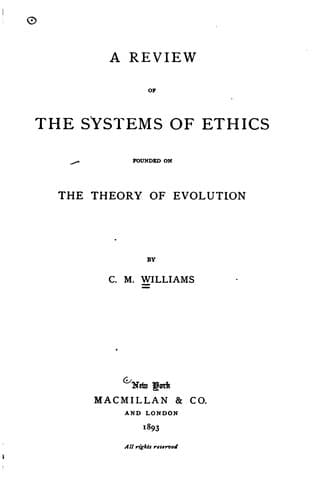
A Review of the Systems of Ethics Founded on the Theory of EvolutionWilliams, Cora May
Philosophy
A Review of the Systems of Ethics Founded on the Theory of Evolution
Williams, Cora May
Ethics, Evolutionary
highest satisfaction of his desire for happiness. It might perhaps be
claimed that Carneri, in his theory of the Conscience, has in this book
laid more stress on feeling than in his others; however, it is to be
recollected that, with him, thought and feeling are no distinct
faculties, but that conscience means less an impulse unconscious of
final ends than a self-conscious attitude or readiness of the will as
the result of conviction.
Carneri's latest book, "Die Lebensfuehrung des modernen Menschen" (1891),
is practical rather than theoretical, a consideration of general
problems and rules of action.
FOOTNOTES:
[65] Wirklich.
[66] Stofflichkeit; by this word Carneri designates "das Gemeinsame
aller Gegenstaendlichkeit."
[67] An sich autonom, unterwirft sich das Leben den Cesetzen, die aus
der allgemeinen Entwicklung sich ergeben.
[68] Daseinstrieb.
[69] Pp. 112, 113.
[70] Dunkle Triebe.
[71] Affecte.
[72] Widerspruchslosigkeit.
[73] Entsprechend.
[74] Gedankenloses Denken.
[75] Gemeinsinn oder Gemeingeist, pp. 340, 410. Carneri explains this
word as equivalent to the English "common-sense," but defines the latter
as feeling for the general, the universal.
[76] Potenz.
HARALD HOeFFDING
"ETHICS" ("Ethik," 1887)
Ethical judgments contain an estimate of the worth of human actions.
Every such estimate presupposes the existence of a need, a feeling which
spurs us on to the judgment of the action, as also the existence of a
standard, an ideal, according to which we judge. The motive to the
ethical judgment may be called the basis of Ethics. The standard
involved in the ethical judgment determines the content of Ethics, in
that it decides which actions, which directions and modes of life, are
to be called good in the ethical sense. The ethical basis is the
subjective, the standard the objective, principle in Ethics; the
character of an ethical conception depends upon this presupposed basis,
the applied standard, and the relation between the two.
The feelings and impulses of the individual are not only influenced by
his own experience, but bear also a character derived from the
experience of the whole species; hence the ethical judgments delivered
by the individual are the result of the whole experience of his kind. It
is by virtue of this circumstance that the ethical system of the
individual gains its power; as ethics of the species, it is a condition
of the health and vitality of human life.
This actual working Ethics of the species and of life has been named
Positive Morality. Such Positive Morality manifests itself in the
every-day judgments and principles of men, often in the form of
proverbs, and may express either the enduring worldly wisdom of a
nation, a tribe, or a religious society, or the less enduring "public
opinion" of a century or an epoch.
Public-domain text, read in full here on John Shaqi.
Reviews
Reviews
No reviews yet
Be the first to share your thoughts on this work.
Elsewhere in the archive
Join the Discussion
Join the discussion
Sign in to leave a comment or review.
Sign InorCreate an account