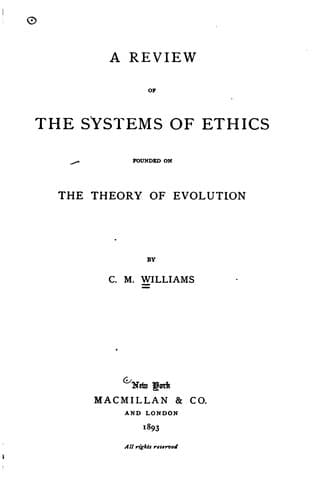
A Review of the Systems of Ethics Founded on the Theory of EvolutionWilliams, Cora May
Philosophy
A Review of the Systems of Ethics Founded on the Theory of Evolution
Williams, Cora May
Ethics, Evolutionary
This change or adjustment leads to a maladjustment requiring a new
adjustment. This maladjustment is to be distinguished from the
reaerrangements which are contemplated by the statical ideal and due to
the mere rotation of wants in society; the latter are within the moral
system as a system of mobile equilibrium. The maladjustment is of
another sort. "The good act ceases to be good by its performance. The
moral ideal ceases to satisfy." The two forms of change may be compared
respectively to a shifting of position on the same locus, and to such a
shifting of position as involves a shifting of locus. Thus, by change
after change of this sort, a new variety replaces its parent, and this
variety in time producing a fresh variety, there is finally reached a
new species. Progress thus becomes a necessary fact, and the difference
of so-called stationary societies from progressive ones can lie only in
the comparative slowness of change.
"As there is a difference between different societies in rate of change,
so there is a similar difference as between different parts of conduct."
Law, a part of morality, lags behind in moral progress. However, there
is nevertheless always advancement, otherwise legislators would be
unnecessary. And the direct outward change of form is preceded by other
change, laws which fall into disfavor by means of moral progress being
modified, in application, within the possible limits of interpretation,
and less and less rigidly enforced. There is good reason why law should
have a certain permanence.
The moral standard appears to have a similar more or less fixed
character, while morality itself is in continuous change. There are two
reasons for this appearance: (1) the changes in the moral order are
infinitesimal and not perceived by us except as accumulated through some
period of time; and, moreover, what is commonly called the moral
standard is only a kind of generalization from the extremely various
opinions of different persons as to what is right, and differs from the
real standard which "registers the conduct constituting equilibrium, and
is possessed by the good man. Perfectly good men are impossible. The
standard current is therefore nothing more than a common understanding,
which every one, even every good man, expresses differently; it is no
more an exact expression of the truth than is, let us say, a great
scientific conception (like development) which regulates all knowledge,
but is amongst the educated little more than the name of a general way
of thinking, while the thing itself is becoming, at the hands of men of
science, modified or even transformed." (2) The mistake is often made of
describing morality, not by institutions, but in terms of virtues, and
while the name applied to different virtues remains the same, their
content changes from age to age.
Public-domain text, read in full here on John Shaqi.
Reviews
Reviews
No reviews yet
Be the first to share your thoughts on this work.
Elsewhere in the archive
Join the Discussion
Join the discussion
Sign in to leave a comment or review.
Sign InorCreate an account