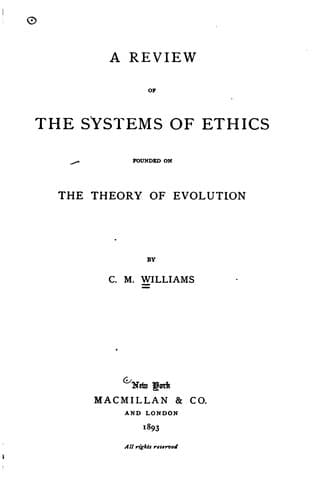
A Review of the Systems of Ethics Founded on the Theory of EvolutionWilliams, Cora May
Philosophy
A Review of the Systems of Ethics Founded on the Theory of Evolution
Williams, Cora May
Ethics, Evolutionary
At the present time, a belief has gained great authority, that the sense
of duty is transitory and will finally disappear; but whether we, with
Spencer, identify obligation with coercion, or understand it as the
relation of a part of conduct to the rest, in neither sense is the
proposition true as it stands. If duty means constraint, it by no means
follows that constraint will cease with progress; for constraint arises
from confronting one inclination with a higher idea, and its
disappearance would mean that inclinations had become constant; this is,
however, impossible. The fiction of a final stage of mobile equilibrium
is an unwarranted conclusion from the fact that all morality involves a
cycle of conduct in mobile equilibrium. But the theory represents a
truth,--the truth that morality at no time implies in itself the sense
of duty. The sense of duty, as involving the hard feeling of compulsion,
of subjection to authority, and bound up with the sense of sin, a sense
stronger in proportion to merit or the interval between first
inclination and final moral willing, may and is giving place to a higher
conception. In the family, this may already be found, where
self-sacrifice and aid are matters of affection and rendered freely. In
the higher ideal, we have that love of man for a higher and larger order
than himself which morality represents as solidarity with society, a
continually progressive society of free individuals; which religion
represents as the love for and of God.
And at the last two questions may be asked: (1) whether the difficulties
in which Christianity is placed at the present day do not arise from
absorption of its highest idea into the conceptions and the practice of
morality, so that the religious sentiment is starved; and (2) whether
the ideal of a free cooeperation in the progress of humanity may not be
used to interpret the belief in immortality, putting in the place of
individual immortality the continuance of life in the persons whom the
individual may affect. In "The International Journal of Ethics" July,
1892, Alexander combats some misinterpretations of "Natural Selection in
Morals," which he says are partly due to Spencer's Individualism.
Natural Selection in social life does not mean necessarily destruction
of individuals, but is a struggle of ideals, such as that between
Individualism and Collectivism,--in which Selection seems to favor
Collectivism.
FOOTNOTES:
[82] The reference is here to Wundt, "Phys. Psych.," I. p. 485 (ed.
II.).
APPENDIX TO PART I
PAUL REE
Public-domain text, read in full here on John Shaqi.
Reviews
Reviews
No reviews yet
Be the first to share your thoughts on this work.
Elsewhere in the archive
Join the Discussion
Join the discussion
Sign in to leave a comment or review.
Sign InorCreate an account