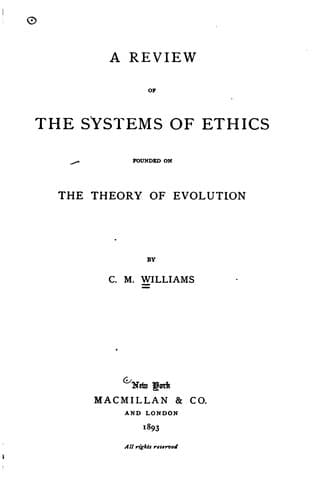
A Review of the Systems of Ethics Founded on the Theory of EvolutionWilliams, Cora May
Philosophy
A Review of the Systems of Ethics Founded on the Theory of Evolution
Williams, Cora May
Ethics, Evolutionary
The will is not free; the mistake of regarding it as free is the result
of the failure to perceive that punishment looks to the future, not to
the past,--is a means of prevention, not a requital. The right to punish
does not rest, therefore, upon the Sense of Justice; but punishment is
justifiable as a means of prevention. Its choice, like that of other
evils as the alternatives of greater ones, is the practice of the
principle, The end justifies the means. Those who repudiate this
principle have not generally looked deeply into its meaning; moreover,
it has been misused. In putting it in practice, several things must be
observed:--
1. The end to be served must be a good one;
2. The choice of means causing pain is permissible only when no other
means are possible;
3. The pain must be reduced to the least possible;
4. The pain must be less than would be involved in the omission of this
particular choice.
* * * * *
The doctrine of eternal punishment is untenable, because:--
1. It presupposes the existence of a God.
2. Supposing a God to be existent, we cannot name him either good or
bad. "God is good" means "He does good to the world and its
inhabitants"; but of the world we know only the little earth, and of God
we know nothing.
3. If we will, nevertheless, predicate goodness or badness of God, we
must call him bad, since all beings known to us suffer much pain and
have little pleasure. The gods of the savages, who are not yet led away
by theological hair-splitting, are evil.
4. But if we still persist in naming God good, then we cannot suppose
him to be also cruel, and even more cruel than the hardest-hearted of
mortals.
5. The doctrine of eternal punishment assumes the existence of a soul;
but the difference between human beings and the higher animals is not so
great that one can ascribe an especial soul to men.
6. But if a soul exists, it cannot be tortured, since it is immaterial.
7. And the deeds which God will thus punish deserve, on the theory of
punishment as prevention, no requital.
* * * * *
It is not immaterial to us whether men have a good or an evil opinion of
us.
1. Because we hope for advantages from a good opinion.
2. Because we are vain.
Public-domain text, read in full here on John Shaqi.
Reviews
Reviews
No reviews yet
Be the first to share your thoughts on this work.
Elsewhere in the archive
Join the Discussion
Join the discussion
Sign in to leave a comment or review.
Sign InorCreate an account