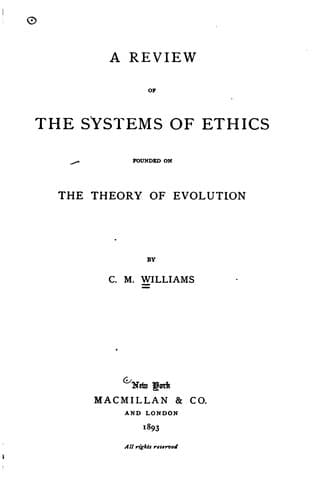
A Review of the Systems of Ethics Founded on the Theory of EvolutionWilliams, Cora May
Philosophy
A Review of the Systems of Ethics Founded on the Theory of Evolution
Williams, Cora May
Ethics, Evolutionary
FOOTNOTES:
[83] P. 46.
[84] P. 78.
[85] See, in contradistinction to Ree's theory of vanity, Sigwart's
admirable essay on this subject, contained in his "Kleine Schriften."
[86] Dr. Ree appears to depart from his general theory here and identify
sympathy with morality.
A REVIEW OF EVOLUTIONAL ETHICS
PART II
INTRODUCTION
Twenty years ago, any one about to deal with moral science from the
standpoint of the Theory of Evolution, might have deemed it necessary to
preface his work with a statement of cogent reasons for the assumption
of such a standpoint. At a time when Theology saw in Darwinism only a
weapon of the anti-theological party, and when even many scientists were
not yet decided as to the worth of the new ideas, the right of the
student to make use of them in psychological and ethical investigations
might have been a subject for dispute. Yet even in the beginning the
attitude of apology was assumed oftener without, than within,
English-speaking countries, for the very reason that exactly among the
race from which Darwin sprang, the warfare of his conception of animate
nature with older systems was fiercest. At the present date, the
attitude of opinion is changed in all countries. The Theory of Evolution
has few, if it can be said to have any, enemies among the students of
science. "With Louis Agassiz died the last opponent of Darwinism
deserving scientific notice," says Haeckel.[87] Theology itself has
ceased from extreme hostilities, and many theologians have even found in
the idea of Evolution an argument with which to defend teleological
doctrine. The present opponents of Darwinism as applied to psychology
and ethics rather contest its special worth for these provinces than
deny its validity in them. Nevertheless, a universal acceptance cannot
be claimed for the theory; and since ethics is, above all other
sciences, the one that should most desire to persuade rather than to
alienate,--and this the more, the stronger its conviction of its own
truth,--it may be well to state or restate some of the reasons which
justify, from almost all modern standpoints, at least a tentative
application of the ideas of Evolution to ethical theory. Such a
statement, or restatement, must be an attempt to demonstrate the
validity of the theory in this province, and to give some good reasons
for supposing, _a priori_, that a survey of ethical questions from the
point of view it furnishes may be of ethical utility. The proof of such
utility can be found, ultimately, only in the results of the
investigation itself.
Public-domain text, read in full here on John Shaqi.
Reviews
Reviews
No reviews yet
Be the first to share your thoughts on this work.
Elsewhere in the archive
Join the Discussion
Join the discussion
Sign in to leave a comment or review.
Sign InorCreate an account