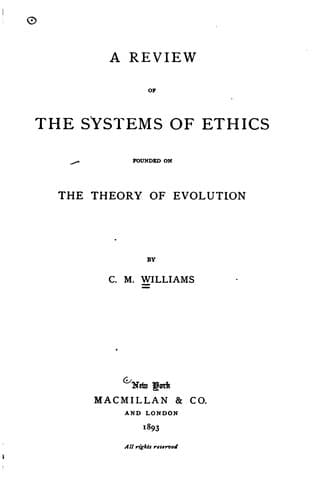
A Review of the Systems of Ethics Founded on the Theory of EvolutionWilliams, Cora May
Philosophy
A Review of the Systems of Ethics Founded on the Theory of Evolution
Williams, Cora May
Ethics, Evolutionary
Of the altruistic sentiments, Spencer says: "The development of these
has gone on only as fast as society has advanced to a state in which the
activities are mainly peaceful. The root of all the altruistic
sentiments is sympathy, and sympathy could become dominant only when the
mode of life, instead of being one that habitually inflicted direct
pain, became one which conferred direct and indirect benefits; the pains
inflicted being mainly incidental and indirect." Sympathy is "the
concomitant of gregariousness; the two having all along increased by
reciprocal aid."
"If we suppose all thought of rewards or punishments, immediate or
remote, to be left out of consideration, it is clear that any one who
hesitates to inflict a pain because of the vivid representation of that
pain which rises in his consciousness, is restrained not by any sense of
obligation or by any formulated doctrine of utility, but by the painful
associations established in him. And it is clear that if, after repeated
experiences of the moral discomfort he has felt from witnessing the
unhappiness indirectly caused by some of his acts, he is led to check
himself when again tempted to those acts, the restraint is of like
nature. Conversely with the pleasure-giving acts, repetitions of kind
deeds and experiences of the sympathetic gratifications that follow tend
continually to make stronger the association between deeds and feelings
of happiness."
Spencer continues: "Eventually these experiences may be consciously
generalized, and there may result a deliberate pursuit of the
sympathetic gratifications. There may also come to be distinctly
recognized the truths that the remoter results are respectively
detrimental and beneficial--that due regard for others is conducive to
ultimate personal welfare, and disregard of others to ultimate personal
disaster; and then there may become current such summations of
experience as 'honesty is the best policy.' But so far from regarding
these intellectual recognitions of utility as preceding and causing the
moral sentiment, I regard the moral sentiment as preceding such
recognitions of utility and making them possible. The pleasures and
pains directly resulting, in experience, from sympathetic and
unsympathetic actions, had first to be slowly associated with such
actions, and the resulting incentives and deterrents frequently obeyed,
before there could arise the perceptions that sympathetic and
unsympathetic actions are remotely beneficial or detrimental to the
actor; and they had to be obeyed still longer and more generally before
there could arise the perceptions that they are socially beneficial and
detrimental. When, however, the remote effects, personal and social,
have gained general recognition, are expressed in current maxims, and
lead to injunctions having the religious sanction, the sentiments that
prompt sympathetic actions and check unsympathetic ones, are immensely
strengthened by their alliances.
Public-domain text, read in full here on John Shaqi.
Reviews
Reviews
No reviews yet
Be the first to share your thoughts on this work.
Join the Discussion
Join the discussion
Sign in to leave a comment or review.
Sign InorCreate an account