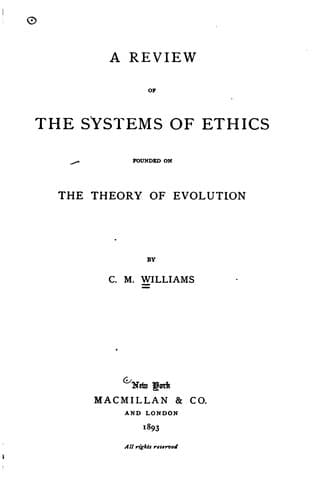
A Review of the Systems of Ethics Founded on the Theory of EvolutionWilliams, Cora May
Philosophy
A Review of the Systems of Ethics Founded on the Theory of Evolution
Williams, Cora May
Ethics, Evolutionary
Approbation and reprobation, divine and
human, come to be associated in thought with the sympathetic and
unsympathetic actions respectively. The commands of a creed, the legal
penalties, and the code of social conduct, mutually enforce them; and
every child, as it grows up, daily has impressed on it, by the words and
faces and voices of those around, the authority of these highest
principles."
The altruistic sentiments develop, and altruistic action becomes
habitual, "until at length these altruistic sentiments begin to call in
question the authority of those ego-altruistic sentiments which once
ruled unchallenged."
And Spencer sums up his objections to the interpretation of his theory
of the development of the moral sentiment as follows: "What I have said
will make it clear that two fundamental errors have been made in the
interpretation put upon it. Both Utility and Experience have been
construed in senses much too narrow.
"Utility, convenient a word as it is from its comprehensiveness, has
very inconvenient and misleading implications. It vividly suggests uses
and means and proximate ends, but very faintly suggests the pleasures,
positive or negative, which are the ultimate ends, and which, in the
ethical meaning of the word, are alone considered; and, further, it
implies conscious recognition of means and ends--implies the deliberate
taking of some course to gain a perceived benefit. Experience, too, in
its ordinary acceptation, connotes definite perceptions of causes and
consequences, as standing in observed relations, and is not taken to
include the connections found in consciousness between states that occur
together, when the relation between them, causal or other, is not
perceived. It is in their widest senses, however, that I habitually use
these words, as will be manifest to every one who reads the 'Principles
of Psychology.'"
In his essay on Prison Ethics (1860), Spencer says: "The antagonistic
schools of morals, like many other antagonistic schools, are both right
and both wrong. The _a priori_ school has its truth; the _a posteriori_
school has its truth; and for the proper guidance of conduct there
should be due recognition of both. On the one hand, it is asserted that
there is an absolute standard of rectitude; and respecting certain
classes of actions, it is rightly asserted. From the fundamental laws of
life and the conditions of social existence are deducible certain
imperative limitations to individual action--limitations which are
essential to a perfect life, individual and social; or, in other words,
essential to the greatest possible happiness. And these limitations,
following inevitably as they do from undeniable first principles, deep
as the nature of life itself, constitute what we may distinguish as
absolute morality.
Public-domain text, read in full here on John Shaqi.
Reviews
Reviews
No reviews yet
Be the first to share your thoughts on this work.
Join the Discussion
Join the discussion
Sign in to leave a comment or review.
Sign InorCreate an account