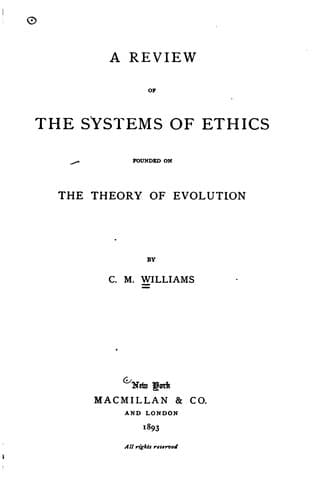
A Review of the Systems of Ethics Founded on the Theory of EvolutionWilliams, Cora May
Philosophy
A Review of the Systems of Ethics Founded on the Theory of Evolution
Williams, Cora May
Ethics, Evolutionary
The doctrine that correlatives imply one another has, for one of its
common examples, the relation between the conceptions of whole and part.
Beyond the primary truth that no idea of a whole can be framed without a
nascent idea of parts constituting it, and that no idea of a part can be
framed without a nascent idea of some whole to which it belongs, there
is the secondary truth that there can be no correct idea of a part
without a correct idea of the correlative whole. Still less, when part
and whole are dynamically related, and least of all when the whole is
organic, can the part be understood except by comprehension of the whole
to which it belongs. This truth holds not only of material but also of
immaterial aggregates.
Conduct is a whole and, in a sense, an organic whole, and Ethics, of
which it is a part, cannot be understood except through the
understanding of the whole of conduct.
A definition of conduct must exclude purposeless actions,--such, for
instance, as those of an epileptic in a fit. Hence the definition
emerges either: acts adjusted to ends; or, the adjustment of acts to
ends; according as we contemplate the formed body of acts, or think of
the form alone. And conduct, in its full acceptation, must be taken as
comprehending all adjustments of acts to ends, from the simplest to the
most complex, whatever their special natures and whether they are
considered separately or in their totality.
A large part of conduct is non-ethical, indifferent; this passes, by
small degrees and in countless ways, into conduct which is either moral
or immoral.
The acts of all living creatures, as acts adjusted to ends, come within
the definition of conduct; the conduct of the higher animals as compared
with that of man, and of the lower animals as compared with the higher,
differs mainly in that the adjustments of acts to ends is relatively
simple and relatively incomplete. And as in other cases, so in this
case, we must interpret the more developed by the less developed; human
conduct as a part of the whole of the conduct of animate beings. And
further: as, in order to understand the part of human conduct with which
Ethics is concerned, we must study it as a part of human conduct as a
whole, and in order to understand human conduct, we must again study it
as a part of the whole of conduct exhibited in animate beings, so, in
order to comprehend this too, we must regard it as an outcome of former,
less developed conduct, out of which it has arisen. Our first step must
be to study the evolution of conduct.
Morphology deals with physical structure, physiology with the processes
carried on in the body. But we enter on the subject of conduct when we
begin to study such combinations among the actions of sensory and
motor-organs as are externally manifested.
Public-domain text, read in full here on John Shaqi.
Reviews
Reviews
No reviews yet
Be the first to share your thoughts on this work.
Join the Discussion
Join the discussion
Sign in to leave a comment or review.
Sign InorCreate an account