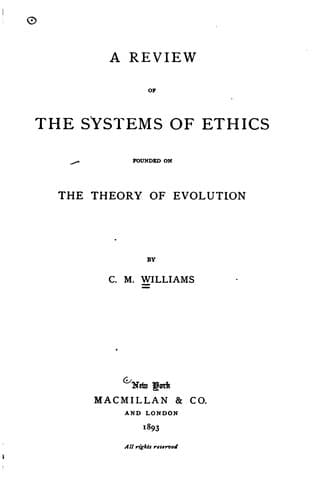
A Review of the Systems of Ethics Founded on the Theory of EvolutionWilliams, Cora May
Philosophy
A Review of the Systems of Ethics Founded on the Theory of Evolution
Williams, Cora May
Ethics, Evolutionary
We saw that conduct is distinguished from the totality of actions by the
exclusion of purposeless actions; but during evolution this distinction
arises by degrees. We trace up conduct to the vertebrates and through
the vertebrates to man, and find that here the adjustments of acts to
ends are both more numerous and better than among lower mammals; and we
find the same thing on comparing the doings of higher races of men with
those of lower. These better adjustments favor, not only prolongation,
but also increased amount of life.
And among these adjustments of acts to ends, there are not only such as
further individual life but also, evolving with these, such as favor the
life of the species. Race-maintaining conduct, like self-maintaining
conduct, arises gradually out of that which cannot be called conduct.
The multitudinous creatures of all kinds which fill the earth are
engaged in a continuous struggle for existence, in which the adjustments
of acts to ends, being imperfectly evolved, miss completeness because
they cannot be made by one creature without other creatures being
prevented from making them. This imperfectly evolved conduct introduces
us, by antithesis, to conduct which is perfectly evolved,--such
adjustments that each creature may make them without preventing other
creatures making them also. The conditions of such conduct cannot exist
in predatory savage life; nor can it exist where there remains
antagonism between individuals forming a group, or between groups of
individuals,--two traits of life necessarily associated, since the
nature which prompts international aggression prompts aggression of
individuals on one another also. Hence the limit of evolution can be
reached by conduct only in permanently peaceful societies; can be
approached only as war decreases and dies out.
The principle of beneficence is not derived by Spencer from the
principle of freedom, in "Social Statics"; and here, as in the latter
book, Spencer has difficulty with it. He says: "A gap in this outline
must now be filled up. There remains a further advance not yet even
hinted. For beyond so behaving that each achieves his ends without
preventing others from achieving their ends, the members of a society
may give mutual help in the achievement of ends. And if either
indirectly by industrial cooeperation, or directly by volunteered aid,
fellow-citizens can make easier for one another the adjustments of acts
to ends, then their conduct assumes a still higher phase of evolution;
since whatever facilitates the making of adjustments by each increases
the totality of the adjustments made, and serves to render the lives of
all more complete."
Thus, then, says Spencer, "we have been led to see that Ethics has for
its subject-matter that form which universal conduct assumes during the
last stages of its evolution."
Public-domain text, read in full here on John Shaqi.
Reviews
Reviews
No reviews yet
Be the first to share your thoughts on this work.
Elsewhere in the archive
Join the Discussion
Join the discussion
Sign in to leave a comment or review.
Sign InorCreate an account