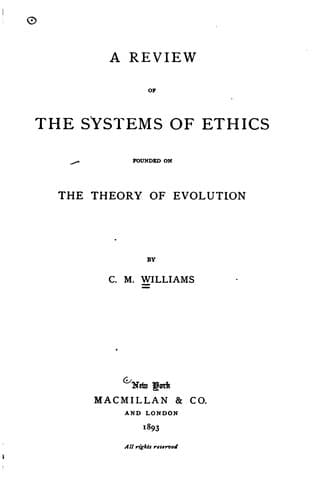
A Review of the Systems of Ethics Founded on the Theory of EvolutionWilliams, Cora May
Philosophy
A Review of the Systems of Ethics Founded on the Theory of Evolution
Williams, Cora May
Ethics, Evolutionary
By comparing the meanings of a word in different connections, and
observing what they have in common, we learn its essential significance.
Material objects we are accustomed to designate as good or bad according
as they are well or ill adapted to achieve prescribed ends. The good
knife is one which will cut; the good gun is one which will carry far
and true; and so on. So of inanimate actions, and so, also, of living
things and actions. A good jump is a jump which, remoter ends ignored,
well achieves the immediate purpose of a jump; and a stroke at billiards
is called good when the movements are skilfully adjusted to the
requirements. So too our use of the words good and bad with respect to
conduct under its ethical aspects has regard to the efficiency or
non-efficiency of the adjustments of acts to ends. This last truth is,
through the entanglements of social relations, by which men's actions
often simultaneously affect the welfares of self, of offspring, and of
fellow-citizens, somewhat disguised. Nevertheless, when we disentangle
the three orders of ends, and consider each separately, it becomes clear
that the conduct which achieves each kind of end is regarded as
relatively good; and conduct which fails to achieve it is regarded as
relatively bad. The goodness ascribed to a man of business, as such, is
measured by the activity and ability with which he buys and sells to
advantage, and may coexist with a hard treatment of dependents which is
reprobated. The ethical judgments we pass on such self-regarding acts
are ordinarily little emphasized; partly because the promptings of the
self-regarding desires, generally strong enough, do not need moral
enforcement, and partly because the promptings of the other-regarding
desires, less strong, do need moral enforcement. With regard to the
second class of adjustments of acts to ends, which subserve the rearing
of offspring, we no longer find any obscurity in the application of the
words good and bad to them, according as they are efficient or
inefficient. And most emphatic are the application of the words, in this
sense, throughout the third division of conduct comprising the deeds by
which men affect one another. Always, then, acts are good or bad,
according as they are well or ill-adapted to ends. That is, good is the
name we apply to the relatively more evolved conduct; and bad is the
name we apply to that which is relatively less evolved; for we have seen
that "evolution, tending ever towards self-preservation, reaches its
limits when individual life is the greatest, both in length and breadth;
and we now see that, leaving other ends aside, we regard as good the
conduct furthering self-preservation, and as bad the conduct tending to
self-destruction." With increasing power of maintaining individual life
goes increasing power of perpetuating the species by fostering progeny;
and the establishment of an associated state both makes possible and
Public-domain text, read in full here on John Shaqi.
Reviews
Reviews
No reviews yet
Be the first to share your thoughts on this work.
Elsewhere in the archive
Join the Discussion
Join the discussion
Sign in to leave a comment or review.
Sign InorCreate an account