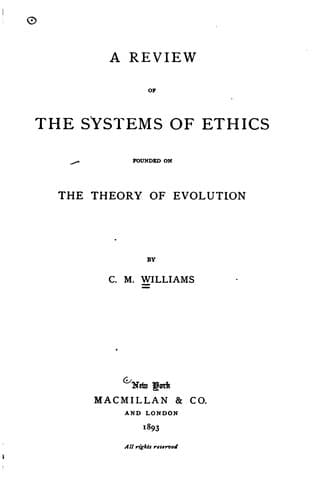
A Review of the Systems of Ethics Founded on the Theory of EvolutionWilliams, Cora May
Philosophy
A Review of the Systems of Ethics Founded on the Theory of Evolution
Williams, Cora May
Ethics, Evolutionary
Here follow criticisms of the religious school of morals, which bases
its system on the will of God, and of the school of "pure
intuitionists," who hold "that men have been divinely endowed with moral
faculties." "It must be either admitted or denied that the acts called
good and the acts called bad naturally conduce, the one to human
well-being and the other to human ill-being. Is it admitted? Then the
admission amounts to an assertion that the conduciveness is shown by
experience; and this involves abandonment of the doctrine that there is
no origin for morals apart from divine injunctions. Is it denied that
acts classed as good and bad differ in their effects? Then it is tacitly
affirmed that human affairs would go on just as well in ignorance of
the distinction; and the alleged need for commandments from God
disappears." To affirm that we know some things to be right and other
things to be wrong, by virtue of a supernaturally given conscience; and
thus tacitly to affirm that we do not otherwise know right from wrong,
is tacitly to deny any natural relations between acts and results. For
if there exist any such relations, then we may ascertain by induction,
or deduction, or both, what these are. And if it be admitted that
because of such natural relations happiness is produced by this kind of
conduct, which is therefore to be approved; while misery is produced by
that kind of conduct, which is therefore to be condemned; then it is
admitted that the rightness or wrongness of actions is determinable, and
must finally be determined, by the goodness or badness of the effects
that flow from them, which is contrary to the hypothesis. Spencer also
repeats and enlarges upon his formerly stated objections to
utilitarianism as superficial: "The utilitarianism which recognizes only
the principles of conduct reached by induction, is but preparatory to
the utilitarianism which deduces these principles from the processes of
life as carried on under established conditions of existence."
Public-domain text, read in full here on John Shaqi.
Reviews
Reviews
No reviews yet
Be the first to share your thoughts on this work.
Elsewhere in the archive
Join the Discussion
Join the discussion
Sign in to leave a comment or review.
Sign InorCreate an account