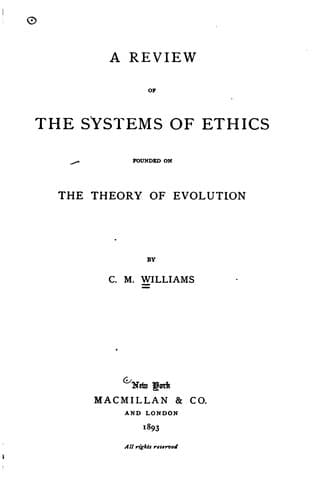
A Review of the Systems of Ethics Founded on the Theory of EvolutionWilliams, Cora May
Philosophy
A Review of the Systems of Ethics Founded on the Theory of Evolution
Williams, Cora May
Ethics, Evolutionary
Every science begins by accumulating observations, and presently
generalizes these empirically, but only when it reaches the stage at
which its empirical generalizations are included in a rational
generalization, does it become developed science. So with Ethics; a
preparation in the simpler sciences is presupposed. It has a biological
aspect; since it concerns certain effects, inner and outer, individual
and social, of the vital changes going on in the highest type of
animals. It has a psychological aspect; for its subject-matter is an
aggregate of actions that are prompted by feelings and guided by
intelligence. And it has a sociological aspect; for these actions, some
of them directly, and all of them indirectly, affect associated beings.
Belonging under one aspect of each of these sciences,--physical,
biological, psychological, sociological,--it can find its ultimate
interpretations only in those fundamental truths which are common to all
of them, as different aspects of evolving life.
THE PHYSICAL VIEW
While an aggregate evolves, not only the matter composing it, but also
the motion of that matter, passes from an indefinite, incoherent
homogeneity to a definite, coherent, heterogeneity. It is so with
conduct. The conduct of lowly organized creatures has its successive
portions feebly connected. From these up to man may be observed an
increase in cohesion. Man, even in his lowest state, displays in his
conduct far more coherent combinations of motions; and in civilized man
this trait of developed conduct becomes more conspicuous still. But an
even greater coherence among its component motions broadly distinguishes
the conduct we call moral from the conduct we call immoral. The
application of the word dissolute to the last, and of the word
self-restrained to the first, implies this fact. The sequences of
conduct in the moral man are more easily to be specified, as implied by
the word trustworthy applied to them; while those of the less principled
man cannot be so specified; as is implied by the word untrustworthy.
Indefiniteness accompanies incoherence in conduct that is little
evolved; and throughout the ascending stages of evolving conduct there
is an increasingly definite cooerdination of the motions constituting it,
until we reach the conscientious man, who is exact in all his
transactions. With this increase of definiteness and coherence goes also
an increase of heterogeneity; the moral man performs more varied duties,
adjustments of acts to ends in more varied relations, than does the
immoral man.
Evolution in conduct is, like all other evolution, towards
equilibrium,--not the equilibrium reached by the individual in death,
but a moving equilibrium. His evolution consists in a continual
adjustment of inner to outer relations, until a state of society shall
be reached in which the individual will find his nature congruous with
the environment.
THE BIOLOGICAL VIEW
Public-domain text, read in full here on John Shaqi.
Reviews
Reviews
No reviews yet
Be the first to share your thoughts on this work.
Elsewhere in the archive
Join the Discussion
Join the discussion
Sign in to leave a comment or review.
Sign InorCreate an account