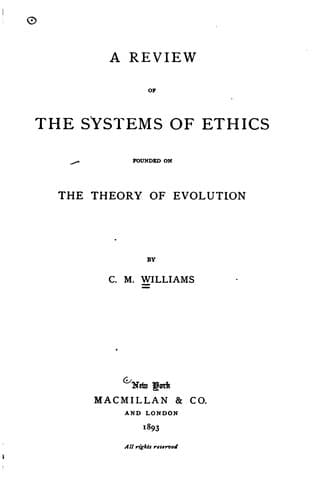
A Review of the Systems of Ethics Founded on the Theory of EvolutionWilliams, Cora May
Philosophy
A Review of the Systems of Ethics Founded on the Theory of Evolution
Williams, Cora May
Ethics, Evolutionary
"The truth that the ideally moral man is one in whom the moving
equilibrium is perfect, or approaches nearest to perfection, becomes,
when translated with physiological language, the truth that he is one in
whom the functions of all kinds are duly fulfilled." Either excess or
defect in the performance of function results in a lowering of life, for
the time being at least. Hence, the performance of every function is, in
a sense, a moral obligation. One test of action is thus given us. An
action must be classed as right or wrong in respect of its immediate
bearings, according as it does or does not tend either to the
maintenance of complete life for the time being or the prolongation of
life to its full extent. This is true even though the remoter bearings
of the action may call for a different classification. The seeming
paradoxy of this statement results from the tendency, so difficult to
avoid, to judge a conclusion which presupposes an ideal humanity, by its
applicability to humanity as now existing. In the ideal state, towards
which evolution tends, any falling short of function implies deviation
from perfectly moral conduct.
"Fit connections between acts and results must establish themselves in
living things, even before consciousness arises; and after the rise of
consciousness these connections can change in no other way than to
become better established. At the very outset, life is maintained by
persistence in acts which conduce to it and desistence from acts which
impede it; and whenever sentience makes its appearance as an
accompaniment, its forms must be such that in the one case the produced
feeling is of a kind that will be sought--pleasure, and in the other
case is of a kind that will be shunned--pain." So, in the case of the
seizure of food, for example, "the pleasurable sensation," everywhere
where it arises, must be itself the stimulus to the contraction by which
the pleasurable sensation is maintained and increased; or must be so
bound up with the stimulus that the two increase together. "And this
relation, which we see is directly established in the case of a
fundamental function, must be indirectly established with all other
functions; since non-establishment of it in any particular case implies,
in so far, unfitness to the conditions of existence." "Sentient
existence can evolve only on condition that pleasure-giving acts are
life-sustaining acts."
It is true that, in mankind as at present constituted, guidance by
present or proximate pleasures and pains fails throughout a wide range
of cases. This arises throughout evolution by changes in the
environment, from which result partial misadjustments of the feelings,
necessitating readjustments. This general cause of derangement has been
operating on human beings in the changes from a primitive to a
civilized condition through the direct opposition and struggle of the
militant and the industrial spirit, in a manner unusually decided,
persistent, and involved.
Public-domain text, read in full here on John Shaqi.
Reviews
Reviews
No reviews yet
Be the first to share your thoughts on this work.
Elsewhere in the archive
Join the Discussion
Join the discussion
Sign in to leave a comment or review.
Sign InorCreate an account