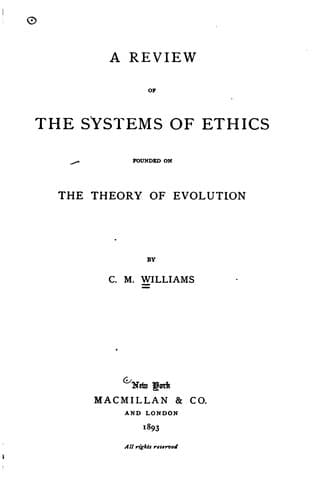
A Review of the Systems of Ethics Founded on the Theory of EvolutionWilliams, Cora May
Philosophy
A Review of the Systems of Ethics Founded on the Theory of Evolution
Williams, Cora May
Ethics, Evolutionary
In general it is imperfect, in that the sustentation of multitudinous
species depends on the wholesale destruction of others; so that, in the
species serving as prey, the relations between conduct and consequence
are so habitually broken that in very few individuals are they long
maintained. It is true the destruction of the species serving as prey is
the result of their natures; "but this violent ending of the immense
majority implies that the species is one in which justice, as above
conceived, is displayed in but small measure." Sub-human justice is also
imperfect in detail, in that the relation between conduct and
consequences is, in such an immense proportion of cases, broken by
accidents,--such as scarcity of food, inclemencies of weather, invasions
by parasites, attacks of enemies,--which fall indiscriminately on the
superior and the inferior. As organization becomes higher, sub-human
justice becomes more decided; as general superiority increases, there
is less dependence on accident, and individual differences become more
important.
With the beginning of gregariousness, we find the new element of
cooeperation, passive or active, which is an advantage to the species.
This involves so much restraint of conflicting acts as will leave a
balance of advantage; else survival of the fittest will exterminate the
variety in which association begins. The experience of the evils of not
maintaining such limits to action results in an inherited tendency to
maintain them. The general consciousness of the need for maintaining
them results in punishment of their disregard. Self-subordination among
solitary animals is found only in parenthood; among gregarious animals
there is a further subjection of the individual to his kind, and where
an occasional sacrifice of life furthers the preservation of species,
sub-human justice may rightly have this second limitation.
Public-domain text, read in full here on John Shaqi.
Reviews
Reviews
No reviews yet
Be the first to share your thoughts on this work.
Elsewhere in the archive
Join the Discussion
Join the discussion
Sign in to leave a comment or review.
Sign InorCreate an account