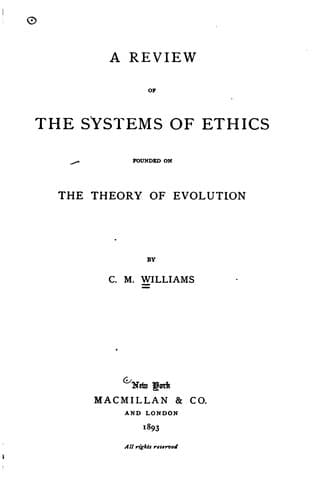
A Review of the Systems of Ethics Founded on the Theory of EvolutionWilliams, Cora May
Philosophy
A Review of the Systems of Ethics Founded on the Theory of Evolution
Williams, Cora May
Ethics, Evolutionary
there generalized that vast mass of them on which all politics and
morals should be built? "Not only are there no such experiences, no such
observations, no such inductions, but it is impossible that any should
be assigned." The like is true of Bentham's rule: "Everybody to count
for one, nobody for more than one," and also of the objection to this
rule, that happiness cannot be divided, or greatest happiness obtained,
by equal division of the means to happiness; they all lead, in the last
analysis, to an _a priori_ belief. Moreover, the rule of natural equity,
the freedom of each limited only by the like freedom of all, is not an
exclusively _a priori_ belief, but although the immediate dictum of the
human consciousness after subjection to the discipline of prolonged
social life, it is deducible from the conditions to be fulfilled,
firstly for the maintenance of life at large, and secondly for the
maintenance of social life.
Rights, properly so-called, are corollaries from the law of equal
freedom, and "so far is it from its being true, as some claim, that the
warrant for what are properly called rights is derived from law, it is,
conversely, true that law derives its warrant from them."
In the application of this theory to practical questions, Mr. Spencer's
"Justice" differs from "Social Statics," which it resembles in form and
method, in general in the greatly increased conservatism of the views
expressed. This is shown in all parts of the book, though perhaps most
clearly in those parts relating to the Rights of Women, to the Land
Question, and to the Limits of State-Duties. "Social Statics" advocated
land-nationalization; but "Justice," though still asserting the original
right of the aggregate of men forming the community to the use of the
earth, as that from which all material objects capable of being owned
are derived and so that on which the right to property is originally
dependent, denies the expediency and the justice of a present
redistribution of the land according to this principle; and this because
of the confusion of claims at the present time, the impossibility of
ascertaining whose ancestors were the robbers and whose the robbed in
the gradually arising monopoly, the wrong of making descendants
responsible for the sins of their ancestors, and leaving those now
dependent on the land without compensation for their loss, and the fact
that any claim to the land is merely a claim to it in its original
condition, not in its present state of drainage and cultivation effected
by the labor of generations. Moreover, "under the existing system of
ownership, those who manage the land experience a direct connection
between effort and benefit, while, were it under state-ownership, those
who managed it would experience no such direct connection. The vices of
officialism would inevitably entail immense evils."
Public-domain text, read in full here on John Shaqi.
Reviews
Reviews
No reviews yet
Be the first to share your thoughts on this work.
Elsewhere in the archive
Join the Discussion
Join the discussion
Sign in to leave a comment or review.
Sign InorCreate an account