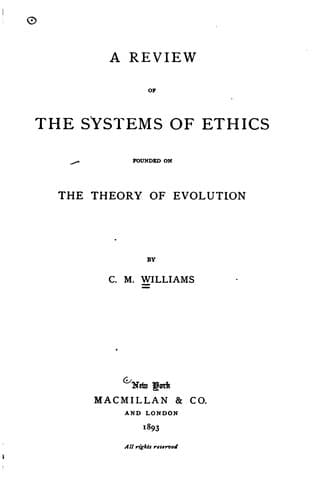
A Review of the Systems of Ethics Founded on the Theory of EvolutionWilliams, Cora May
Philosophy
A Review of the Systems of Ethics Founded on the Theory of Evolution
Williams, Cora May
Ethics, Evolutionary
"For now let us observe that the ethical sentiment and idea, properly
so-called, are independent of the ideas and sentiments above described
as derived from external authorities, and coercions, and
approbations--religious, political, or social. The true moral
consciousness which we name conscience does not refer to those extrinsic
results of conduct which take the shape of praise or blame, reward or
punishment, externally awarded; but it refers to the intrinsic results
of conduct which in part and by some intellectually perceived, are
mainly and by most intuitively felt. The moral consciousness proper
does not contemplate obligations as artificially imposed by an external
power; nor is it chiefly occupied with estimates of the amounts of
pleasure and pain which given actions may produce, though these may be
clearly or dimly perceived; but it is chiefly occupied with recognition
of, and regard for, those _conditions_ by fulfilment of which happiness
is achieved or misery avoided." It may or may not be in harmony with the
pro-ethical sentiment; but in any case it is "vaguely or distinctly
recognized as the rightful ruler, responding as it does to consequences
which are not artificial and variable, but to consequences which are
natural and permanent." With the established supremacy of this ethical
sentiment, the feeling of obligation retires into the background, right
actions being performed "spontaneously or from liking." "Though, while
the moral nature is imperfectly developed, there may often arise
conformity to the ethical sentiment under a sense of compulsion by it;
and though, in other cases, non-conformity to it may cause subsequent
self-reproach (as instance a remembered lack of gratitude, which may be
a source of pain without there being any thought of extrinsic penalty);
yet with a moral nature completely balanced, neither of these feelings
will arise, because that which is done is done in satisfaction of the
appropriate desire."
Where the really ethical sentiment conflicts with the factitious idea
and sentiment of obedience to legal authority, the latter may rule at
the expense of the former, as, for instance, in the case of a pedler
condemned for selling without a license. "His act of selling is morally
justifiable, and forbidding him to sell without a license is morally
unjustifiable--is an interference with his due liberty which is
ethically unwarranted."
Public-domain text, read in full here on John Shaqi.
Reviews
Reviews
No reviews yet
Be the first to share your thoughts on this work.
Elsewhere in the archive
Join the Discussion
Join the discussion
Sign in to leave a comment or review.
Sign InorCreate an account