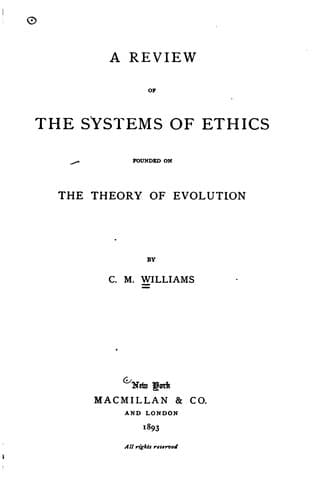
A Review of the Systems of Ethics Founded on the Theory of EvolutionWilliams, Cora May
Philosophy
A Review of the Systems of Ethics Founded on the Theory of Evolution
Williams, Cora May
Ethics, Evolutionary
Part III. of the "Principles of Ethics" is occupied with practical
considerations concerning "The Ethics of Individual Life," under the
headings "Activity," "Rest," "Nutrition," "Stimulation," "Culture,"
"Amusements," "Marriage," "Parenthood." Of the general ethical relation
of the individual to society, Spencer says:--"Integration being the
primary process of evolution, we may expect that the aggregate of
conceptions constituting ethics enlarges at the same time that its
components acquire heterogeneity, definiteness, and that kind of
cohesion which system gives to them. As fulfilling this expectation, we
may first note that while drawing within its range of judgment numerous
actions of men towards one another which at first were not recognized as
right or wrong, it finally takes into its sphere the various divisions
of private conduct--those actions of each individual which directly
concern himself only, and in but remote ways concern his fellows."
Ethics has been commonly regarded as merely a system of interdicts on
certain kinds of acts which men would like to do and of injunctions to
perform certain acts which they would like not to do. It says nothing
about the great mass of acts constituting normal life, though these have
their ethical aspect. The pleasurable has been too often regarded as
outside the legitimate sphere of ethical approval, where not directly
the rightful subject of ethical disapproval. But pleasure is an
accompaniment of vitality, and furthers the vital activities; and if the
general happiness is to be the aim of action, then the happiness of each
unit is a fit aim; and there is unquestionably "a division of ethics
which yields sanction to all the normal actions of individual life,
while it forbids the abnormal ones." There is an altruistic as well as
an egoistic justification of the care for self, since the health of
descendants and the ability to provide for offspring is directly
concerned; and since such care is needful to exclude the risk of
becoming a burden to others. And there is a further positive
justification of egoism which results from the obligation to expend some
effort for others, and to become, as far as possible, a source of social
pleasure to others.
It will be seen, from the above analysis, that the chapter appended to
Part I. still speaks of an ultimate state of complete adjustment to
social life[52]; this chapter was, however, published from the original
MS. without alteration. Some passages in Part II. seem to involve the
same idea of a possible complete attainment of the ethical end,[53] but
Part III. closes with reference to "an approximately complete adjustment
of the nature to the life which has to be led."
FOOTNOTES:
[38] Spencer elsewhere says "due exercise," _vide_ p. 76.
[39] Essay on "Morals and Moral Sentiment."
[40] P. 105.
[41] _Vide_ "Principles of Psychology."
[42] P. 104.
[43] Pp. 104,105.
[44] Pp. 108, 109.
[45] Pp. 134, 148.
[46] P. 147.
[47] Pp. 202, 203.
Public-domain text, read in full here on John Shaqi.
Reviews
Reviews
No reviews yet
Be the first to share your thoughts on this work.
Elsewhere in the archive
Join the Discussion
Join the discussion
Sign in to leave a comment or review.
Sign InorCreate an account