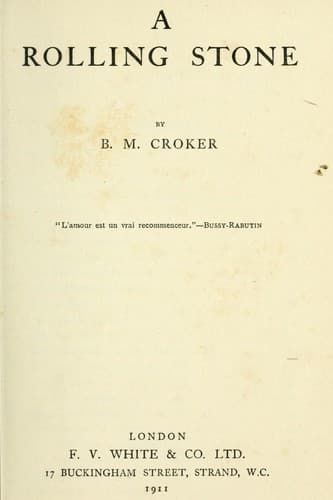
England -- Social life and customs -- 20th century -- Fiction; Household employees -- Fiction; Young men -- Fiction
Listening with tightly folded hands, the slim figure in black accorded
him her entire sympathy. Now she was in possession of all his
confidence, and such was his unhappy plight, he was desperately in love
with a girl, and could neither speak nor show a sign--nor make his real
position known. What an amazing state of affairs! Did Aurea recognise
in Wynyard a silent worshipper? And was it not true that love and smoke
cannot be concealed?
“You will keep this to yourself, I know,” he said. “I’m not _sure_ that
I’m within my right in telling you, but somehow I had to.”
“You may be certain I shall never breathe it till you give me
permission,” she answered, drawing a long breath; “but what an
extraordinary man your uncle must be!”
“Yes, he is eccentric; but I believe he is right--this sort of
apprenticeship will do me a jolly lot of good. I know more of the
people now I’m one of them. Many a thing I’ve learnt here, that I’d
never have had a glimpse of, and I must tell you fair and square that I
gave Uncle Dick a lot of bother in the way of my debts.”
“Hereditary extravagance--your father--a younger son--drove a
four-in-hand, you know. Ah, here comes Aurea,” as the little gate
swung. “I half promised to go over there this evening.”
“Then good-bye, I’m off; I’ll finish the packing to-morrow,” and he
escaped through the back garden.
It was abundantly evident that of late Miss Morven avoided him, and he
had not spoken to her since the tragic occasion when they both hung
over a dying man on the high road to Upstreet.
More than six months had gone by since he had come to Ottinge;
sometimes it seemed an endless time, at others as but yesterday. One
thing was clear and stationary in his mind--his living among working
people had opened the eyes of a future landowner, given him a better
estimate of his responsibilities, and a sympathy and understanding that
nothing could obliterate.
At last Ivy House was closed; the blinds were drawn down, the key hung
in Mrs. Hogben’s bedroom, and the memory of the recent catastrophe had
become a little dim. It was three weeks since the Captain had killed
himself, and other events had begun to press upon public attention.
Since the tragedy Aurea had absolutely refused to drive in the motor,
to her Aunt Bella’s great annoyance; she was painfully anxious to have
it in daily use, for she feared that being the cause of a man’s death
might depreciate the car’s value! And when the girl announced she would
never get into it again, she was furious, and her face assumed a dull
red shade as she asked--
“Do you mean to tell me that, if there’s an accident to a carriage, or
if a cart runs over somebody, that cart is never to be used? How could
people get on?” she demanded. “I never heard of such affected nonsense.
And now I suppose you will go and give my nice car a bad name? As if it
could help the madman throwing himself under it!”
Public-domain text, read in full here on John Shaqi.
Reviews
Reviews
No reviews yet
Be the first to share your thoughts on this work.
Elsewhere in the archive
Join the Discussion
Join the discussion
Sign in to leave a comment or review.
Sign InorCreate an account