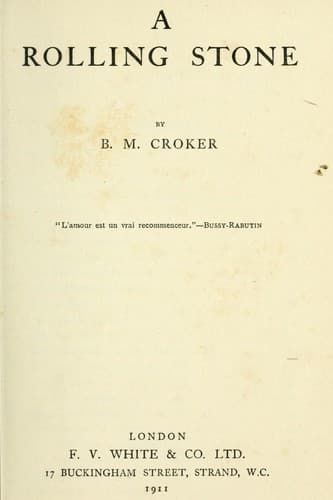
England -- Social life and customs -- 20th century -- Fiction; Household employees -- Fiction; Young men -- Fiction
“Only once or twice, miss, when my hand was sore. His people are poor,
and a shilling doesn’t come amiss.”
“I feel certain,” clearing her throat, “that you are not accustomed to
this sort of life, Owen.” As she spoke, she kept her clear blue eyes
on his face, and looked at him with the direct simplicity of a child.
“I am interested in you, Owen. Do tell me about yourself, you know I
wish you well.”
“Miss Susan,” and he straightened his shoulders and set down the pot
he was holding, “you received my reference from Lady Kesters--and I
believe it was all right?”
Miss Susan became very red indeed, and the garden scissors slipped from
her thumb. There was something unusual in the young man’s tone and
glance.
“If you or Miss Parrett find that I am not giving satisfaction----”
“Oh no, no, no!” she broke in breathlessly, “I--I’m afraid I’m rather
inquisitive--but I take a real interest in you, and you have been
_such_ a help to me--and I feel so friendly towards you--but, I won’t
ask you any more questions.”
This little scene was subsequently related to Aurea, as she and her
aunt drank tea together at the Rectory, and Miss Susan imparted to the
girl--between bites of buttered toast--her own eager speculations.
Mystery has a wonderful charm! A handsome young man, who was both
reserved and obliging, who, it was known, was respected in the Drum,
and kept to himself, and whom she believes to be one of her own
class--offers a dangerous attraction for a girl of twenty! Aurea
debated the puzzle in the abysmal depth of her own heart, and when a
girl once allows her thoughts to dwell persistently upon a man--no
matter what his station--her interest in him is bound to develop far
beyond the bounds of everyday acquaintance!
Aurea was startled to discover that her mind was dwelling on the
chauffeur more than was desirable; he occupied too large a share of
her thoughts, though she did her utmost to expel him, and fill them
with other matters--such, for instance, as the parish almshouses, the
clothing club, and the choir--but a taciturn, mysterious young man,
figuratively, thrust himself head and shoulders above these commonplace
matters. Owen had a good voice, and had been impressed into the
choir--a rollicking hunting song, sung at the Drum, had betrayed him.
It was customary there, on certain nights, to sit round in a circle and
call upon the members for entertainment, and Owen’s “John Peel” had
established his reputation.
Public-domain text, read in full here on John Shaqi.
Reviews
Reviews
No reviews yet
Be the first to share your thoughts on this work.
Elsewhere in the archive
Join the Discussion
Join the discussion
Sign in to leave a comment or review.
Sign InorCreate an account