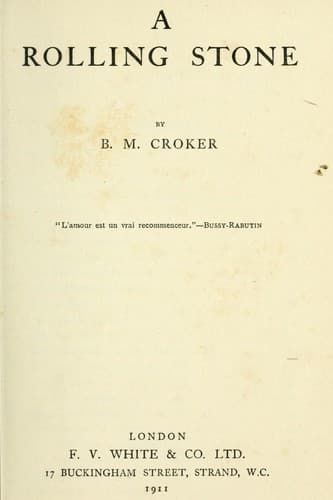
England -- Social life and customs -- 20th century -- Fiction; Household employees -- Fiction; Young men -- Fiction
“Howsomever, the last time I was so rarely fond of the pig, and his
screams and carryings-on cut me so _cruel_, that I made a vow, then and
there, I’d never own another, but take a lodger instead--and you, Jack,
be the _first_!”
“I’m sure I’m flattered,” rejoined Wynyard, with an irony entirely
wasted on his companion, who, with her skirt turned over her knees,
and her feet generously displayed, sat at the other side of the fire,
thoroughly enjoying herself.
“Tom is out,” he said, and this remark started her at once into another
topic, and a series of bitter complaints of Dilly Topham--Tom’s girl.
“The worst of it is, she’s mighty pretty, ain’t she?” she asked
querulously.
“She is,” he admitted. Dilly was a round-faced, smiling damsel, with
curly brown hair and expressive blue eyes--a flirt to her finger-tips.
It was also true that she did lead poor Tom a life, and encouraged a
smart young insurance agent, with well-turned, stockinged calves, and a
free-wheel bicycle.
“I’d never put up with her,” declared Mrs. Hogben, “only for her
grandmother.”
“Why her grandmother?” he questioned lazily.
“Bless your dear heart, old Jane Topham has been a miser all her
life. Oh, she’s a masterpiece, she is, and lives on the scrapings of
the shop; she hasn’t had a gown this ten year, but has a fine lump of
money in the Brodfield Bank, and Dilly is all she’s got left, and the
apple of her eye. Dilly will have a big fortune--only for that, I’d put
her to the door, with her giggling and her impudence, yes I would, and
that’s the middle and the two ends of it!”
When Wynyard had heard more than enough of Dilly’s doings and
misdoings, and the biographies and tragedies of his predecessors (the
pigs), he went over to the Drum, listened to discussions, and realised
the prominent characteristics of the English rustic--reluctance to
accept a new idea. Many talked as if the world had not moved for thirty
years, and evinced a dull-witted contentment, a stolid refusal to look
facts in the face; but others, the younger generation, gave him a new
perspective--these read the papers, debated their contents, and took a
keen interest in their own times.
Wynyard generally had a word with old Thunder, and played a game of
chess with Pither, the organist. Captain Ramsay was established in his
usual place--smoking, silent, and staring. So intent was his gaze,
so insistently fixed, that Wynyard invariably arranged to sit with
his back to him, but even then he seemed to feel the piercing eyes
penetrating the middle of his spine!
One evening Captain Ramsay suddenly rose, and shuffled out of his
corner--an usual proceeding, for he remained immovable till closing
time (ten o’clock). He came straight up to where Wynyard was bending
over the chess-board, considering a move, and laying a heavy hand on
his shoulder, and speaking in a husky voice, said--
“I say--_Wynyard_--don’t you know me?”
CHAPTER XVII
LADY KESTERS HAS MISGIVINGS
Public-domain text, read in full here on John Shaqi.
Reviews
Reviews
No reviews yet
Be the first to share your thoughts on this work.
Elsewhere in the archive
Join the Discussion
Join the discussion
Sign in to leave a comment or review.
Sign InorCreate an account