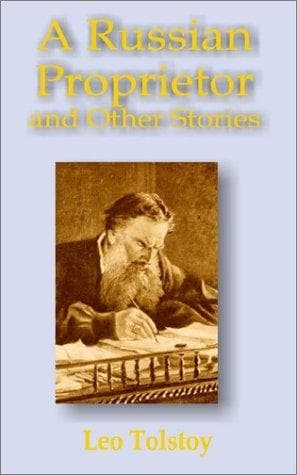
A Russian Proprietor, and Other StoriesTolstoy, Leo, graf
General
A Russian Proprietor, and Other Stories
Tolstoy, Leo, graf
Russia -- Social life and customs -- Fiction; Tolstoy, Leo, graf, 1828-1910 -- Translations into English
He went to sleep about noon, and slept that heavy, dreamless sleep,
peculiar to very young men who have been losing heavily. Waking at six,
about the time that Count Turbin had arrived at the hotel, and seeing cards
and chalk and soiled tables scattered around him in confusion in the room,
he remembered with horror the evening's games, and the last card, a knave,
which had lost him five hundred rubles; but, still scarcely believing in
the reality, he drew out from under his pillow his money, and began to
count it. He recognized a few notes which, with corners turned down and
indorsements, had gone from hand to hand around the table; he remembered
all the particulars. He had lost his own three thousand rubles, and
twenty-five hundred belonging to the treasury had disappeared.
The uhlan had been playing for four nights in succession.
He had come from Moscow, where the public money had been intrusted to him.
At K. the post-superintendent had detained him under the pretext that there
were no post-horses, but in reality in accordance with his agreement with
the hotel-keeper to detain all visitors for a day.
The uhlan, who was a gay young fellow, and had just received from his
parent three thousand rubles for his military equipment, was glad to spend
a few days in the city of K. during the elections, and counted on having a
good time.
He knew a landed proprietor whose family lived there, and he was preparing
to call upon him and pay his addresses to his daughter, when the cavalryman
appeared, and made his acquaintance. That very evening, without malice
prepense, he took him down into the parlor, and introduced him to his
friends, Lukhnof and several other gamblers. From that time, the uhlan had
kept steadily at gaming, and not only had not called on the proprietor, but
had not thought of inquiring further for horses, and for four days had not
left his room.
After he had dressed, and taken his tea, he went to the window. He felt an
inclination to go out so as to dispel the importunate recollections of the
game. He put on his cloak, and went into the street.
The sun had just sunk behind the white houses with their red roofs. It was
already twilight. It was warm. The snow was softly falling in big, damp
flakes, in the muddy streets. His mind suddenly became filled with
unendurable melancholy at the thought that he had spent all that day in
sleep, and now the day was done.
"This day which has gone, will never come back again," he said to himself.
"I have wasted my youth," he suddenly exclaimed, not because he really felt
that he had wasted his youth,--he did not think about it at all,--but
simply this phrase came into his head.
"What shall I do now?" he reasoned; "borrow of some one, and go away?"
A lady was passing along the sidewalk.
"What a stupid woman!" he said to himself for some reason.
"There's no one I can borrow of. I have wasted my youth."
Public-domain text, read in full here on John Shaqi.
Reviews
Reviews
No reviews yet
Be the first to share your thoughts on this work.
Elsewhere in the archive
Join the Discussion
Join the discussion
Sign in to leave a comment or review.
Sign InorCreate an account