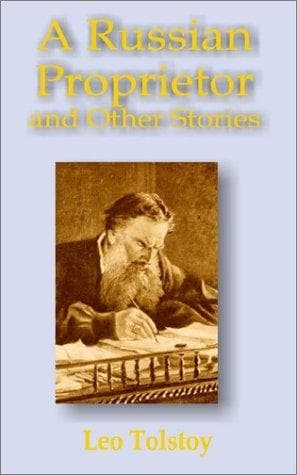
A Russian Proprietor, and Other StoriesTolstoy, Leo, graf
General
A Russian Proprietor, and Other Stories
Tolstoy, Leo, graf
Russia -- Social life and customs -- Fiction; Tolstoy, Leo, graf, 1828-1910 -- Translations into English
The count, by his skill in dancing, eclipsed the three best dancers of the
city. These were, a governor's aide, a tall albino, who was famous for his
rapid dancing and because he held the lady pressed very close to his
breast; secondly, the cavalryman, who was famous for his graceful swaying
during the waltz, and for his frequent but light tapping with his heels;
and thirdly, a civilian of whom everybody said, that, though he was not
very strong-minded, yet he was an admirable dancer and the life of all
balls.
In point of fact, this civilian from the beginning to the end of a ball
invariably invited all the ladies in the order in which they sat, did not
cease for a moment to dance, and only occasionally paused to wipe his
weary but still radiant face with his cambric handkerchief, which would
become wet through.
The count had surpassed them all, and had danced with the three principal
ladies,--with the stout one, who was rich, handsome, and stupid; with the
middle-sized one, who was lean, and not particularly good-looking, but
handsomely dressed; and with the little one, who was not pretty, but very
witty.
He had danced also with others,--with all the pretty women, and there were
many pretty women there.
But the little widow, Zavalshevsky's sister, pleased the count more than
all the rest; with her he danced a quadrille and a schottische and a
mazurka.
At first, when they took their places for the quadrille, he overwhelmed her
with compliments, comparing her to Venus and Diana, and to a rosebush, and
to some other flower besides.
To all these amenities the little widow only bent her white neck, modestly
dropped her eyes, and, looking at her white muslin dress, changed her fan
from one hand to the other.
When, at last, she said, "This is too much, count; you are jesting," etc.,
her voice, which was rather guttural, betrayed such _naïve_ simplicity of
heart and amusing naturalness that the count, as he looked at her, actually
compared her, not to a flower or to a rosebush, but to some kind of a
pinkish-white wild-flower, exuberant and odorless, growing alone on a
virgin snow-drift in some far, far-distant land.
Such a strange impression was made upon the count by this union of
_naïveté_ and unconventionality together with fresh beauty, that several
times, in the pauses of the conversation, when he looked silently into her
eyes or contemplated the loveliness of her arms and neck, the desire came
over him with such vehemence to take her into his arms and kiss her again
and again, that he was really obliged to restrain himself.
The little widow was quite satisfied with the impression which she
perceived that she had made; but there was something in the count's
behavior that began to disquiet her, and fill her with apprehensions,
though the young hussar was not only flatteringly amiable, but even, to an
extravagant degree, deferential in his treatment of her.
Public-domain text, read in full here on John Shaqi.
Reviews
Reviews
No reviews yet
Be the first to share your thoughts on this work.
Elsewhere in the archive
Join the Discussion
Join the discussion
Sign in to leave a comment or review.
Sign InorCreate an account