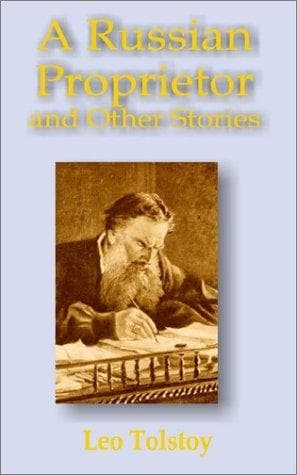
A Russian Proprietor, and Other StoriesTolstoy, Leo, graf
General
A Russian Proprietor, and Other Stories
Tolstoy, Leo, graf
Russia -- Social life and customs -- Fiction; Tolstoy, Leo, graf, 1828-1910 -- Translations into English
After saying good-night to her mother, Liza had gone alone to the room that
had been her uncle's. Putting on a white jacket, throwing a handkerchief
round her thick long braids, she put out the light, opened the window, and
curled up in a chair, turning her dreamy eyes to the pond which was now all
shining with silver brilliancy.
All her ordinary occupations and interests came up before her now in an
entirely different light. Her capricious old mother, unreasoning love for
whom had become a part of her very soul, her feeble but amiable old uncle,
the domestics, the peasants who worshipped their young mistress, the milch
cows and the calves; all this nature which was forever the same in its
continual death and resurrection, amid which she had grown up, with love
for others, and with the love of others for her,--all this that gave her
that gentle, agreeable peace of mind,--suddenly seemed to her something
different; it all seemed to her dismal, superfluous.
It was as though some one said to her, "Fool, fool! For twenty years you
have been occupied in trivialities, you have been serving others without
reason, and you have not known what life, what happiness, were!"
This was what she thought now as she gazed down into the depths of the
motionless moonlit garden, and the thought came over her with vastly more
force than ever before. And what was it that induced this train of thought?
It was not in the least a sudden love for the count, as might easily be
supposed. On the contrary, he did not please her. It might rather have been
the cornet of whom she was thinking; but he was homely, poor, and taciturn.
"No, it isn't that," she said to herself.
Her ideal was so charming! It was an ideal which might have been loved in
the midst of this night, in the midst of this nature, without infringing
its supernal beauty; an ideal not in the least circumscribed by the
necessity of reducing it to coarse reality.
In days gone by, her lonely situation, and the absence of people who might
have attracted her, caused that all the strength of the love which
Providence has implanted impartially in the hearts of each one of us, was
still intact and potential in her soul. But now she had been living too
long with the pathetic happiness of feeling that she possessed in her heart
this something, and occasionally opening the mysterious chalice of her
heart, of rejoicing in the contemplation of its riches, ready to pour out
without stint on some one all that it contained.
God grant that she may not have to take this melancholy delight with her to
the tomb! But who knows if there be any better and more powerful delight,
or if it is not the only true and possible one?
"O Father in heaven," she thought, "is it possible that I have lost my
youth and my happiness, and that they will never return?... Will they never
return again? is it really true?"
Public-domain text, read in full here on John Shaqi.
Reviews
Reviews
No reviews yet
Be the first to share your thoughts on this work.
Elsewhere in the archive
Join the Discussion
Join the discussion
Sign in to leave a comment or review.
Sign InorCreate an account