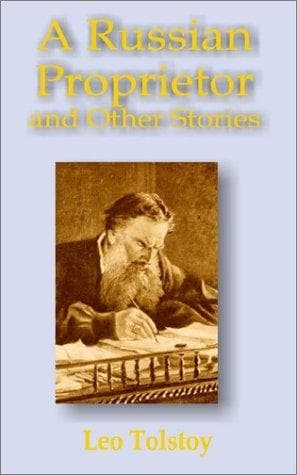
A Russian Proprietor, and Other StoriesTolstoy, Leo, graf
General
A Russian Proprietor, and Other Stories
Tolstoy, Leo, graf
Russia -- Social life and customs -- Fiction; Tolstoy, Leo, graf, 1828-1910 -- Translations into English
The fat smiling face of the hostess was radiant with happiness. The pianist
kept his eyes fixed on Albert's face, and while his whole figure from head
to foot showed his solicitude lest he should make some mistake, he did his
best to follow him. One of the guests, who had been drinking more heavily
than the rest, lay at full length on the sofa, and tried not to move lest
he should betray his emotion. Delesof experienced an unusual sensation. It
seemed as though an icy band, now contracting, now expanding, were pressed
upon his head. The roots of his hair seemed endued with consciousness; the
cold shivers ran down his back, something rose higher and higher in his
throat, his nose and palate were full of little needles, and the tears
stole down his cheeks.
He shook himself, tried to swallow them back and wipe them away without
attracting attention, but fresh tears followed and streamed down his face.
By some sort of strange association of impressions, the first tones of
Albert's violin carried Delesof back to his early youth.
Old before his time, weary of life, a broken man, he suddenly felt as
though he were a boy of seventeen again, self-satisfied and handsome,
blissfully dull, unconsciously happy. He remembered his first love for his
cousin who wore a pink dress, he remembered his first confession of it in
the linden alley; he remembered the warmth and the inexpressible charm of
the fortuitous kiss; he remembered the immensity and enigmatical mystery of
Nature as it surrounded them then.
In his imagination as it went back in its flight, _she_ gleamed in a mist
of indefinite hopes, of incomprehensible desires, and the indubitable faith
in the possibility of impossible happiness. All the priceless moments of
that time, one after the other, arose before him, not like unmeaning
instants of the fleeting present, but like the immutable, full-formed,
reproachful images of the past.
He contemplated them with rapture, and wept,--wept not because the time had
passed and he might have spent it more profitably (if that time had been
given to him again he would not have spent it any more profitably), but he
wept because it had passed and would never return. His recollections
evolved themselves without effort, and Albert's violin was their
mouthpiece. It said, "They have passed, forever passed, the days of thy
strength, of love, and of happiness; passed forever, and never will return.
Weep for them, shed all thy tears, let thy life pass in tears for these
days; this is the only and best happiness that remains to thee."
Public-domain text, read in full here on John Shaqi.
Reviews
Reviews
No reviews yet
Be the first to share your thoughts on this work.
Elsewhere in the archive
Join the Discussion
Join the discussion
Sign in to leave a comment or review.
Sign InorCreate an account