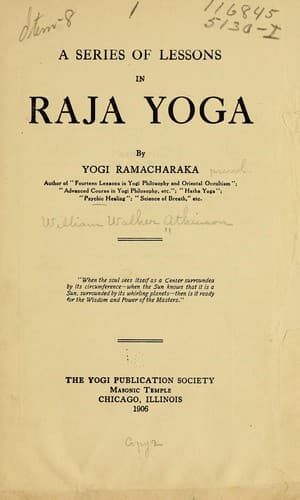
A Series of Lessons in Raja YogaAtkinson, William Walker
Religion
A Series of Lessons in Raja Yoga
Atkinson, William Walker
Yoga; Yoga, Raja
Sir Oliver Lodge, the eminent English scientist, speaking of the planes
of the mind, says: "Imagine an iceberg glorying in its crisp solidity,
and sparkling pinnacles, resenting attention paid to its submerged self,
or supporting region, or to the saline liquid out of which it arose, and
into which in due course it will some day return. Or, reversing the
metaphor, we might liken our present state to that of the hulls of
ships submerged in a dim ocean among strange monsters, propelled in a
blind manner through space; proud perhaps of accumulating many barnacles
as decoration; only recognizing our destination by bumping against the
dock-wall; and with no cognizance of the deck and cabins above us, or
the spars and sails--no thought of the sextant, and the compass, and
the captain--no perception of the lookout on the mast--of the distant
horizon. With no vision of objects far ahead--dangers to be
avoided--destinations to be reached--other ships to be spoken to by
means other than by bodily contact--a region of sunshine and cloud, of
space, or perception, and of intelligence utterly inaccessible to parts
below the waterline."
We ask our students to read carefully the above expression of Sir Oliver
Lodge, for it gives one of the clearest and most accurate figures of the
actual state of affairs concerning the mental planes that we have seen in
Western writings.
And other Western writers have noted and spoken of these out-of-conscious
realms. Lewes has said: "It is very certain that in every conscious
volition--every act that is so characterized--the larger part of it is
quite unconscious. It is equally certain that in every perception there
are unconscious processes of reproduction and inference. There is a
middle distance of sub-consciousness, and a background of
unconsciousness."
Taine has told us that: "Mental events imperceptible to consciousness are
far more numerous than the others, and of the world that makes up our
being we only perceive the highest points--the lighted-up peaks of a
continent whose lower levels remain in the shade. Beneath ordinary
sensations are their components, that is to say, the elementary
sensations, which must be combined into groups to reach our
consciousness."
Maudsley says: "Examine closely and without bias the ordinary mental
operations of daily life, and you will find that consciousness has not
one-tenth part of the function therein which it is commonly assumed
to have. In every conscious state there are at work conscious,
sub-conscious, and infra-conscious energies, the last as indispensable as
the first."
Oliver Wendall Holmes said: "There are thoughts that never emerge into
consciousness, which yet make their influence felt among the perceptible
mental currents, just as the unseen planets sway the movements of those
that are watched and mapped by the astronomer."
Public-domain text, read in full here on John Shaqi.
Reviews
Reviews
No reviews yet
Be the first to share your thoughts on this work.
Elsewhere in the archive
Join the Discussion
Join the discussion
Sign in to leave a comment or review.
Sign InorCreate an account