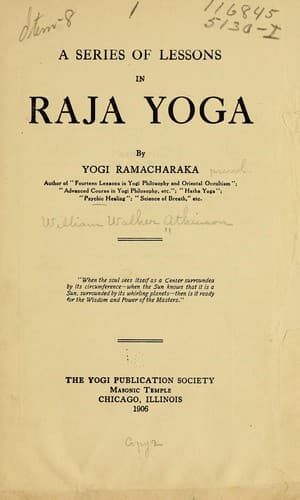
A Series of Lessons in Raja YogaAtkinson, William Walker
Religion
A Series of Lessons in Raja Yoga
Atkinson, William Walker
Yoga; Yoga, Raja
Dr. Schofield says: "It is quite true that the range of the unconscious
mind must necessarily remain indefinite; none can say how high or low it
may reach.... As to how far the unconscious powers of life that, as has
been said, can make eggs and feathers out of Indian corn, and milk and
beef and mutton out of grass, are to be considered within or beyond the
lowest limits of unconscious mind, we do not therefore here press. It is
enough to establish the fact of its existence; to point out its more
important features; and to show that in all respects it is as worthy of
being called mind as that which works in consciousness. We therefore
return to our first definition of Mind, as 'the sum of psychic action in
us, whether conscious or unconscious.'"
Hartmann calls our attention to a very important fact when he says: "The
unconscious does not fall ill, the unconscious does not grow weary, but
all conscious mental activity becomes fatigued."
Kant says: "To have ideas and yet not be conscious of them--therein seems
to lie a contradiction. However, we may still be immediately aware of
holding an idea, though we are not directly conscious of it."
Maudsley says: "It may seem paradoxical to assert not merely that ideas
may exist in the mind without any consciousness of them, but that an
idea, or a train of associated ideas, may be quickened into action and
actuate movements without itself being attended to. When an idea
disappears from consciousness it does not necessarily disappear entirely;
it may remain latent below the horizon of consciousness. Moreover it may
produce an effect upon movement, or upon other ideas, when thus active
below the horizon of consciousness."
Liebnitz says: "It does not follow that because we do not perceive
thought that it does not exist. It is a great source of error to believe
that there is no perception in the mind but that of which it is
conscious."
Oliver Wendell Holmes says: "The more we examine the mechanism of thought
the more we shall see that anterior unconscious action of the mind that
enters largely into all of its processes. People who talk most do not
always think most. I question whether persons who think most--that is who
have most conscious thought pass through their mind--necessarily do most
mental work. Every new idea planted in a real thinker's mind grows when
he is least conscious of it."
Maudsley says: "It would go hard with mankind indeed, if they must act
wittingly before they acted at all. Men, without knowing why, follow a
course for which good reasons exist. Nay, more. The practical instincts
of mankind often work beneficially in actual contradiction to their
professed doctrines."
The same writer says: "The best thoughts of an author are the unwilled
thoughts which surprise himself; and the poet, under the influence of
creative activity, is, so far as consciousness is concerned, being
dictated to."
Public-domain text, read in full here on John Shaqi.
Reviews
Reviews
No reviews yet
Be the first to share your thoughts on this work.
Elsewhere in the archive
Join the Discussion
Join the discussion
Sign in to leave a comment or review.
Sign InorCreate an account