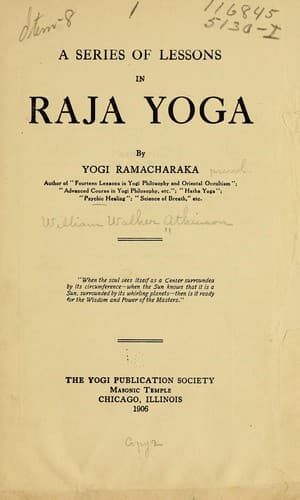
A Series of Lessons in Raja YogaAtkinson, William Walker
Religion
A Series of Lessons in Raja Yoga
Atkinson, William Walker
Yoga; Yoga, Raja
The text books upon psychology are filled with illustrations and examples
of the habit phase or plane of the mental operations, and we do not think
it necessary to repeat instances of the same kind here. Everyone is
familiar with the fact that tasks which at first are learned only by
considerable work and time soon become fixed in some part of the mind
until their repetition calls for little or no exercise of conscious
mental operation. In fact, some writers have claimed that no one really
"learns" how to perform a task until he can perform it almost
automatically. The pupil who in the early stages of piano playing finds
it most difficult to control and manage his fingers, after a time is able
to forget all about his fingering and devote his entire attention to the
pages of his music, and after this he is able to apparently let his
fingers play the entire piece of music by themselves without a thought on
his part. The best performers have told us that in the moments of their
highest efforts they are aware that the out-of-conscious portion of their
mind is doing the work for them, and they are practically standing aside
and witnessing the work being done. So true is this that in some cases it
is related that if the performer's conscious mind attempts to take up the
work the quality is impaired and the musician and the audience notice the
difference.
The same thing is true in the case of the woman learning to operate the
sewing machine. It is quite difficult at first, but gradually it grows to
"run itself." Those who have mastered the typewriter have had the same
experience. At first each letter had to be picked out with care and
effort. After a gradual improvement the operator is enabled to devote her
entire attention to the "copy" and let the fingers pick out the keys for
themselves. Many operators learn rapid typewriting by so training the
habit mind that it picks out the letter-keys by reason of their position,
the letters being covered over in order to force the mind to adapt itself
to the new requirements. A similar state of affairs exists wherever men
or women have to use tools of any kind. The tool soon is recognized by
the mind and used as if it were a part of the body, and no more conscious
thought is devoted to the manipulation than we devote to the operation of
walking, which, by the way, is learned by the child only by the
expenditure of time and labor. It is astonishing how many things we do
"automatically" in this way. Writers have called our attention to the
fact that the average man cannot consciously inform you how he puts on
his coat in the morning--which arm goes in first, how the coat is held,
etc. But the habit mind knows--knows very well. Let the student stand up
and put on his coat in the regular way, following the leadings of the
habit mind. Then, after removing it, let him attempt to put it on by
inserting the other arm first, for instance. He will be surprised to find
Public-domain text, read in full here on John Shaqi.
Reviews
Reviews
No reviews yet
Be the first to share your thoughts on this work.
Elsewhere in the archive
Join the Discussion
Join the discussion
Sign in to leave a comment or review.
Sign InorCreate an account