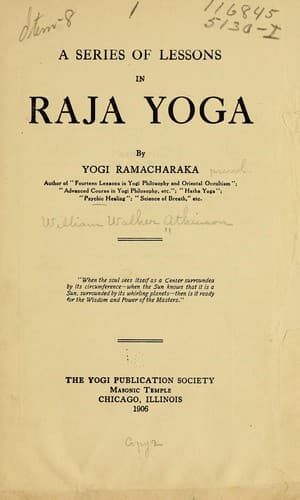
A Series of Lessons in Raja YogaAtkinson, William Walker
Religion
A Series of Lessons in Raja Yoga
Atkinson, William Walker
Yoga; Yoga, Raja
In connection with the above, we may relate an anecdote of _Whateley_
that may be interesting in connection with the consideration of this
subject of "losing one's self" in the task. He was asked for a recipe for
"bashfulness," and replied that the person was bashful simply because he
was thinking of himself and the impression he was making. His recipe was
that the young man should think of others--of the pleasure he could give
them--and in that way he would forget all about himself. The prescription
is said to have effected the cure. The same authority has written, "Let
both the extemporary speaker, and the reader of his own compositions,
study to avoid as far as possible all thoughts of self, earnestly fixing
the mind on the matter of what is delivered; and they will feel less
that embarrassment which arises from the thought of what opinion the
hearers will form of them."
The same writer, _Whateley_, seems to have made quite a study of
Attention and has given us some interesting information on its details.
The following may be read with interest, and if properly understood may
be employed to advantage. He says, "It is a fact, and a very curious one.
that many people find that they can best attend to any serious matter
when they are occupied with something else which requires a little, and
but a little, attention, such as working with the needle, cutting open
paper leaves, or, for want of some such employment, fiddling anyhow with
the fingers." He does not give the reason for this, and at first sight
it might seem like a contradiction of the "one thing at a time" idea. But
a closer examination will show us that the minor work (the cutting
leaves, etc.) is in the nature of an involuntary or automatic movement,
inasmuch as it requires little or no voluntary attention, and seems to
"do itself." It does not take off the Attention from the main subject,
but perhaps acts to catch the "waste Attention" that often tries to
divide the Attention from some voluntary act to another. The habit mind
may be doing one thing, while the Attention is fixed on another. For
instance, one may be writing with his attention firmly fixed upon the
thought he wishes to express, while at the time his hand is doing the
writing, apparently with no attention being given it. But, let a boy, or
person unaccustomed to writing, try to express his thoughts in this way,
and you will find that he is hampered in the flow of his thoughts by the
fact that he has to give much attention to the mechanical act of writing.
In the same way, the beginner on the typewriter finds it difficult to
compose to the machine, while the experienced typist finds the mechanical
movements no hindrance whatever to the flow of thought and focusing of
Attention; in fact, many find that they can compose much better while
using the typewriter than they can by dictating to a stenographer. We
think you will see the principle.
Public-domain text, read in full here on John Shaqi.
Reviews
Reviews
No reviews yet
Be the first to share your thoughts on this work.
Elsewhere in the archive
Join the Discussion
Join the discussion
Sign in to leave a comment or review.
Sign InorCreate an account