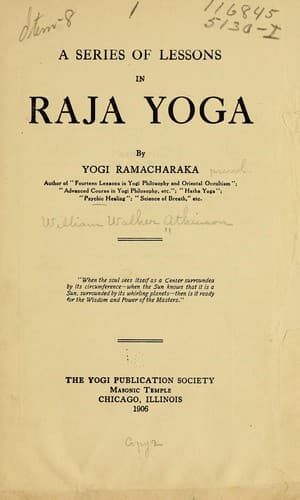
A Series of Lessons in Raja YogaAtkinson, William Walker
Religion
A Series of Lessons in Raja Yoga
Atkinson, William Walker
Yoga; Yoga, Raja
But not only is this true, but Man may increase his powers of knowledge
and experience if he will but develop the senses he has to a higher
degree of efficiency, instead of allowing them to remain comparatively
atrophied. And toward this end, this lesson is written.
The Mind obtains its impressions of objects of the outside world by means
of the brain and sense organs. The sensory organs are the instruments of
the Mind, as is also the brain and the entire nervous system. By means of
the nerves, and the brain, the Mind makes use of the sensory organs in
order that it may obtain information regarding external objects.
The senses are usually said to consist of five different forms, _viz._,
sight, hearing, smell, touch, and taste.
The Yogis teach that there are higher senses, undeveloped, or
comparatively so, in the majority of the race, but toward the unfoldment
of which the race is tending. But we shall not touch upon these latent
senses in this lesson, as they belong to another phase of the subject. In
addition to the five senses above enumerated, some physiologists and
psychologists have held that there were several others in evidence. For
instance, the sense by which the inner organs revealed their presence and
condition, The muscular system reports to the mind through some sense
that is not that of "touch," although closely allied to it. And the
feelings of hunger, thirst, etc., seem to come to us through an unnamed
sense.
Bernstein has distinguished between the five senses and the one just
referred to as follows: "The characteristic distinction between these
common sensations and the sensations of the senses is that by the latter
we gain knowledge of the occurrences and objects which belong to the
external world (and which sensations we refer to external objects),
whilst by the former we only feel conditions of our own body."
A sensation is the internal, mental conception, resulting from an
external object or fact exciting the sense organs and nerves, and the
brain, thus making the mind "aware" of the external object or fact. As
Bain has said, it is the "mental impression, feeling, or conscious state,
resulting from the action of external things on some part of the body,
called on that account, sensitive."
Public-domain text, read in full here on John Shaqi.
Reviews
Reviews
No reviews yet
Be the first to share your thoughts on this work.
Elsewhere in the archive
Join the Discussion
Join the discussion
Sign in to leave a comment or review.
Sign InorCreate an account