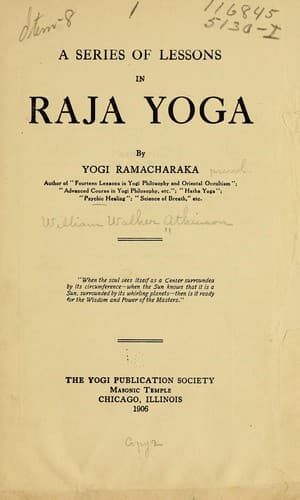
A Series of Lessons in Raja YogaAtkinson, William Walker
Religion
A Series of Lessons in Raja Yoga
Atkinson, William Walker
Yoga; Yoga, Raja
The same rule may be applied to any subject or object. Let us take
another familiar illustration. You wish to observe a building. If you
simply get a general perception of the building as a whole, you will
be able to remember very little about it, except its general outlines,
shape, size, color, etc. And a description will prove to be very
disappointing. But if you have noted, _in detail_, the material used, the
shape of the doors, chimney, roof, porches, decorations, trimmings,
ornamentation, size and number of the window-panes etc., etc., the shape
and angles of the roof, etc., you will have an _intelligent_ idea of the
building, in the place of a mere general outline or impression of such as
might be acquired by an animal in passing.
We will conclude this lesson with an anecdote of the methods of that
famous naturalist Agassiz, in his training of his pupils. His pupils
became renowned for their close powers of observation and perception,
and their consequent ability to "think" about the things they had seen.
Many of them rose to eminent positions, and claimed that this was largely
by reason of their careful training.
The tale runs that a new student presented himself to Agassiz one day,
asking to be set to work. The naturalist took a fish from a jar in which
it had been preserved, and laying it before the young student bade him
observe it carefully, and be ready to report upon what he had noticed
about the fish. The student was then left alone with the fish. There was
nothing especially interesting about that fish--it was like many other
fishes that he had seen before. He noticed that it had fins and scales,
and a mouth and eyes, yes, and a tail. In a half hour he felt certain
that he had observed all about that fish that there was to be perceived.
But the naturalist remained away.
The time rolled on, and the youth, having nothing else to do, began to
grow restless and weary. He started out to hunt up the teacher, but he
failed to find him, and so had to return and gaze again at that
wearisome fish. Several hours had passed, and he knew but little more
about the fish than he did in the first place.
He went out to lunch and when he returned it was still a case of watching
the fish. He felt disgusted and discouraged, and wished he had never come
to Agassiz, whom, it seemed, was a stupid old man after all,--one away
behind the times. Then, in order to kill time, he began to count the
scales. This completed he counted the spines of the fins. Then he began
to draw a picture of the fish. In drawing the picture he noticed that the
fish had no eyelids. He thus made the discovery that as his teacher had
expressed it often, in lectures, "a pencil is the best of eyes." Shortly
after the teacher returned, and after ascertaining what the youth had
observed, he left rather disappointed, telling the boy to keep on looking
and maybe he would see something.
Public-domain text, read in full here on John Shaqi.
Reviews
Reviews
No reviews yet
Be the first to share your thoughts on this work.
Elsewhere in the archive
Join the Discussion
Join the discussion
Sign in to leave a comment or review.
Sign InorCreate an account