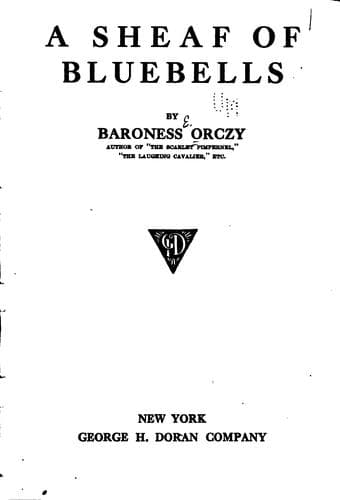
A Sheaf of BluebellsOrczy, Emmuska Orczy, Baroness
History
A Sheaf of Bluebells
Orczy, Emmuska Orczy, Baroness
France -- History -- Consulate and First Empire, 1799-1815 -- Fiction
To Ronnay de Maurel the aspect of La Vieuville seemed infinitely dreary;
the thought of the factories and the foundries singularly uninspiring.
What mattered it that he had come home--a great deal older, a little
more crippled, more impatient and more indifferent? Old Gaston could not
now last more than a few days, and the representatives of the War Office
had seen to it that the output of guns and of munitions did not fall too
far short of the Emperor's needs. Why should a man come home--a man who
had courted death in an hundred desperate fights--a man who had nothing
to live for, no one to care for, no one who would rejoice when he
returned or who would weep if he fell ... when countless precious sons
and brothers and lovers and husbands were left to rot unburied on the
ice-covered plains of Poland, and countless mothers and widows mourned,
broken-hearted, at their loss?
But it was not his way to let things drift. Peace had, of a truth, been
signed at Tilsit, but it was not like to be a lasting peace. The
European Powers had once and for all decided that France was not to
remain in bondage to the Emperor whom she worshipped. He was in
everybody else's way, he must be swept aside in order to make room for
the effete and incompetent Bourbons, who were hanging on to the
coat-tails of England and Austria and Russia, with a view to reaping the
chestnuts which others had pulled out of the fire for them. De Maurel
was one of those who would have preferred their idolized Emperor to sit
at home after this last campaign, to enjoy the fruit of his victories
and to prove to the world that France, when she divested herself of the
old regime, had gained a benefactor, even though she had had to pass
through fire and water, through crime and ignominy, ere she got him. But
to know Napoleon intimately, as did the privileged few, was to realize
that measureless ambition which was destined to hurl him, not only down
from the giddy heights of triumph and of victory whereon his glorious
achievements of the last two campaigns had established him, but also
from his secure place within the heart of his people, a place which he
would only reconquer when his mortal remains were brought back to France
after the years of conflict and of misery which were to come.
II
That all was not well at the factories de Maurel did not fail to
perceive within four-and-twenty hours of his return. The military
overseers had done their duty--the output of munitions, if not lavish,
had been adequate, and there had been no open rebellion among the
workers. But in the first tour of inspection which the master made of
his demesnes he realized how more than surly was the temper of former
malcontents now and how sorely had the loyalty of the honest workmen
been tried.
Public-domain text, read in full here on John Shaqi.
Reviews
Reviews
No reviews yet
Be the first to share your thoughts on this work.
Elsewhere in the archive
Join the Discussion
Join the discussion
Sign in to leave a comment or review.
Sign InorCreate an account