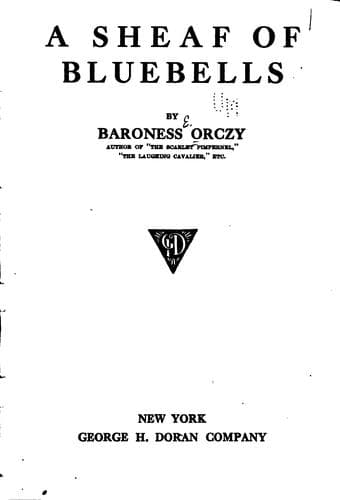
A Sheaf of BluebellsOrczy, Emmuska Orczy, Baroness
History
A Sheaf of Bluebells
Orczy, Emmuska Orczy, Baroness
France -- History -- Consulate and First Empire, 1799-1815 -- Fiction
The place was not picturesque. It was not inviting. The men, stripped to
the waist, were covered with grime. But on their bearded faces they wore
the same look of energy and of determination which glowed in the eyes of
the soldiers who followed the young General Bonaparte over the Alps and
across the Danube, through the snows of Poland and the sands of the
desert from victory to victory. There was the same spirit--of that there
could be no doubt--which had roused the whole nation to defend itself
against the foreigners--the same spirit that made every man, woman and
child, who could not fight the foe, toil in order to help subjugate him.
That de Maurel understood how to deal with the men was equally obvious.
They evidently looked up to and trusted him, and Madame la Marquise's
dream of seeing the proletariat turn against the hands that fed it would
certainly not come true at La Frontenay.
Not that every cog-wheel of the gigantic machinery worked with equal
smoothness. Though, for the most part, de Maurel's progress through his
workshops was accompanied by looks of deference and at times of genuine
affection and gratitude, there were murmurings, too. More than once
Fernande caught the drift of a muttered complaint: "The heaviness of the
toil, the unhealthy conditions, the dearness of food at home." De
Maurel, however, had only one answer for all and sundry: "France," he
said, and his ringing voice sounded above the din of hammers and heavy
tools, above the roar of furnaces and bellows, "France has her back up
against the wall, my men! the whole of Europe is up in arms against her!
every one of her sons must either fight or toil till victory is assured.
After that ... well ... toil will be less hard ... life more healthy ...
food less dear!"
"My wife and children have not tasted meat for a month," retorted one
man moodily.
"I have not tasted any for half a year," was de Maurel's cheerful reply.
"My uncle and I up at La Vieuville live as you do down here; we toil as
you do, suffer as much as you. When the Emperor hath brought the
Prussian to his knees and compelled Austria to sue for peace, we'll all
feast together ... and not before."
"'Tis dog's work sweating in front of these furnaces all the day ..."
growled another man.
"Try sweating in front of the Prussian cannon, _mon ami_," retorted "the
General," with a careless shrug of his broad shoulders.
He passed on and in his wake the murmurings somehow died down. He had a
way with him, and he was so full of energy and breathed vitality from
every pore to such a degree, that instinctively toil appeared lighter,
and it seemed a humiliation to grumble.
It was only in the powder factory that the tempers of the men appeared
of a different mettle.
II
The factory stood some little way from the smelting works. It was
surrounded by a high wall, and its numerous sheds and imposing magazine,
surmounted by a clock-tower, nestled at the foot of the hills some
distance back from the road.
Public-domain text, read in full here on John Shaqi.
Reviews
Reviews
No reviews yet
Be the first to share your thoughts on this work.
Elsewhere in the archive
Join the Discussion
Join the discussion
Sign in to leave a comment or review.
Sign InorCreate an account