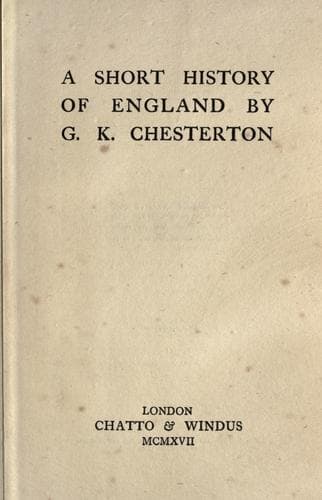
A Short History of EnglandChesterton, G. K. (Gilbert Keith)
History
A Short History of England
Chesterton, G. K. (Gilbert Keith)
Great Britain -- History
We cannot understand the eighteenth century so long as we suppose that
rhetoric is artificial because it is artistic. We do not fall into this
folly about any of the other arts. We talk of a man picking out notes
arranged in ivory on a wooden piano "with much feeling," or of his
pouring out his soul by scraping on cat-gut after a training as careful
as an acrobat's. But we are still haunted with a prejudice that verbal
form and verbal effect must somehow be hypocritical when they are the
link between things so living as a man and a mob. We doubt the feeling
of the old-fashioned orator, because his periods are so rounded and
pointed as to convey his feeling. Now before any criticism of the
eighteenth-century worthies must be put the proviso of their perfect
artistic sincerity. Their oratory was unrhymed poetry, and it had the
humanity of poetry. It was not even unmetrical poetry; that century is
full of great phrases, often spoken on the spur of great moments, which
have in them the throb and recurrence of song, as of a man thinking to
a tune. Nelson's "In honour I gained them, in honour I will die with
them," has more rhythm than much that is called _vers libres_. Patrick
Henry's "Give me liberty or give me death" might be a great line in Walt
Whitman.
It is one of the many quaint perversities of the English to pretend to
be bad speakers; but in fact the most English eighteenth-century epoch
blazed with brilliant speakers. There may have been finer writing in
France; there was no such fine speaking as in England. The Parliament
had faults enough, but it was sincere enough to be rhetorical. The
Parliament was corrupt, as it is now; though the examples of corruption
were then often really made examples, in the sense of warnings, where
they are now examples only in the sense of patterns. The Parliament was
indifferent to the constituencies, as it is now; though perhaps the
constituencies were less indifferent to the Parliament. The Parliament
was snobbish, as it is now, though perhaps more respectful to mere rank
and less to mere wealth. But the Parliament was a Parliament; it did
fulfil its name and duty by talking, and trying to talk well. It did not
merely do things because they do not bear talking about--as it does now.
It was then, to the eternal glory of our country, a great
"talking-shop," not a mere buying and selling shop for financial tips
and official places. And as with any other artist, the care the
eighteenth-century man expended on oratory is a proof of his sincerity,
not a disproof of it. An enthusiastic eulogium by Burke is as rich and
elaborate as a lover's sonnet; but it is because Burke is really
enthusiastic, like the lover. An angry sentence by Junius is as
carefully compounded as a Renascence poison; but it is because Junius is
really angry--like the poisoner. Now, nobody who has realized this
psychological truth can doubt for a moment that many of the English
Public-domain text, read in full here on John Shaqi.
Reviews
Reviews
No reviews yet
Be the first to share your thoughts on this work.
Elsewhere in the archive
Join the Discussion
Join the discussion
Sign in to leave a comment or review.
Sign InorCreate an account