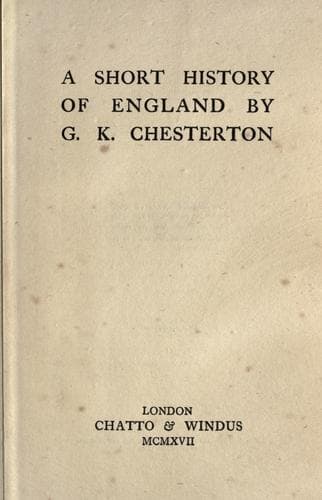
A Short History of EnglandChesterton, G. K. (Gilbert Keith)
History
A Short History of England
Chesterton, G. K. (Gilbert Keith)
Great Britain -- History
If any one wishes to know what we mean when we say that Christendom was
and is one culture, or one civilization, there is a rough but plain way
of putting it. It is by asking what is the most common, or rather the
most commonplace, of all the uses of the word "Christian." There is, of
course, the highest use of all; but it has nowadays many other uses.
Sometimes a Christian means an Evangelical. Sometimes, and more
recently, a Christian means a Quaker. Sometimes a Christian means a
modest person who believes that he bears a resemblance to Christ. But it
has long had one meaning in casual speech among common people, and it
means a culture or a civilization. Ben Gunn on Treasure Island did not
actually say to Jim Hawkins, "I feel myself out of touch with a certain
type of civilization"; but he did say, "I haven't tasted Christian
food." The old wives in a village looking at a lady with short hair and
trousers do not indeed say, "We perceive a divergence between her
culture and our own"; but they do say, "Why can't she dress like a
Christian?" That the sentiment has thus soaked down to the simplest and
even stupidest daily talk is but one evidence that Christendom was a
very real thing. But it was also, as we have seen, a very localized
thing, especially in the Middle Ages. And that very lively localism the
Christian faith and affections encouraged led at last to an excessive
and exclusive parochialism. There were rival shrines of the same saint,
and a sort of duel between two statues of the same divinity. By a
process it is now our difficult duty to follow, a real estrangement
between European peoples began. Men began to feel that foreigners did
not eat or drink like Christians, and even, when the philosophic schism
came, to doubt if they were Christians.
Public-domain text, read in full here on John Shaqi.
Reviews
Reviews
No reviews yet
Be the first to share your thoughts on this work.
Elsewhere in the archive
Join the Discussion
Join the discussion
Sign in to leave a comment or review.
Sign InorCreate an account