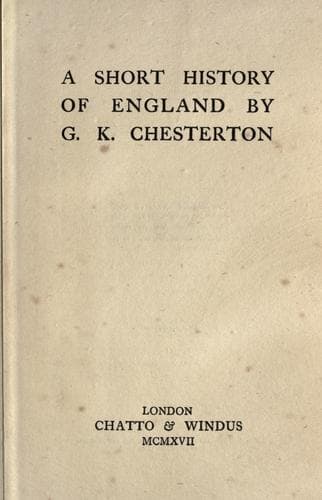
A Short History of EnglandChesterton, G. K. (Gilbert Keith)
History
A Short History of England
Chesterton, G. K. (Gilbert Keith)
Great Britain -- History
There was, indeed, much more than this involved. While the internal
structure of mediaevalism was thus parochial and largely popular, in the
greater affairs, and especially the external affairs, such as peace and
war, most (though by no means all) of what was mediaeval was monarchical.
To see what the kings came to mean we must glance back at the great
background, as of darkness and daybreak, against which the first figures
of our history have already appeared. That background was the war with
the barbarians. While it lasted Christendom was not only one nation but
more like one city--and a besieged city. Wessex was but one wall or
Paris one tower of it; and in one tongue and spirit Bede might have
chronicled the siege of Paris or Abbo sung the song of Alfred. What
followed was a conquest and a conversion; all the end of the Dark Ages
and the dawn of mediaevalism is full of the evangelizing of barbarism.
And it is the paradox of the Crusades that though the Saracen was
superficially more civilized than the Christian, it was a sound instinct
which saw him also to be in spirit a destroyer. In the simpler case of
northern heathenry the civilization spread with a simplier progress. But
it was not till the end of the Middle Ages, and close on the
Reformation, that the people of Prussia, the wild land lying beyond
Germany, were baptized at all. A flippant person, if he permitted
himself a profane confusion with vaccination, might almost be inclined
to suggest that for some reason it didn't "take" even then.
The barbarian peril was thus brought under bit by bit, and even in the
case of Islam the alien power which could not be crushed was evidently
curbed. The Crusades became hopeless, but they also became needless. As
these fears faded the princes of Europe, who had come together to face
them, were left facing each other. They had more leisure to find that
their own captaincies clashed; but this would easily have been
overruled, or would have produced a petty riot, had not the true
creative spontaneity, of which we have spoken in the local life, tended
to real variety. Royalties found they were representatives almost
without knowing it; and many a king insisting on a genealogical tree or
a title-deed found he spoke for the forests and the songs of a whole
country-side. In England especially the transition is typified in the
accident which raised to the throne one of the noblest men of the Middle
Ages.
Public-domain text, read in full here on John Shaqi.
Reviews
Reviews
No reviews yet
Be the first to share your thoughts on this work.
Elsewhere in the archive
Join the Discussion
Join the discussion
Sign in to leave a comment or review.
Sign InorCreate an account