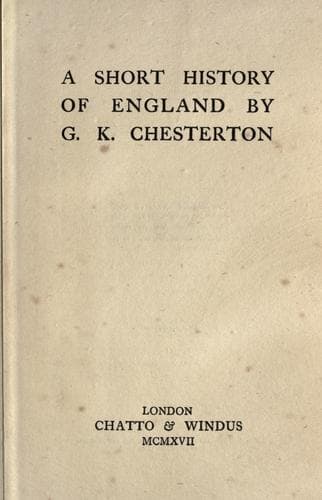
A Short History of EnglandChesterton, G. K. (Gilbert Keith)
History
A Short History of England
Chesterton, G. K. (Gilbert Keith)
Great Britain -- History
Edward I. came clad in all the splendours of his epoch. He had taken the
Cross and fought the Saracens; he had been the only worthy foe of Simon
de Montfort in those baronial wars which, as we have seen, were the
first sign (however faint) of a serious theory that England should be
ruled by its barons rather than its kings. He proceeded, like Simon de
Montfort, and more solidly, to develop the great mediaeval institution of
a parliament. As has been said, it was superimposed on the existing
parish democracies, and was first merely the summoning of local
representatives to advise on local taxation. Indeed its rise was one
with the rise of what we now call taxation; and there is thus a thread
of theory leading to its latter claims to have the sole right of taxing.
But in the beginning it was an instrument of the most equitable kings,
and notably an instrument of Edward I. He often quarrelled with his
parliaments and may sometimes have displeased his people (which has
never been at all the same thing), but on the whole he was supremely the
representative sovereign. In this connection one curious and difficult
question may be considered here, though it marks the end of a story
that began with the Norman Conquest. It is pretty certain that he was
never more truly a representative king, one might say a republican king,
than in the fact that he expelled the Jews. The problem is so much
misunderstood and mixed with notions of a stupid spite against a gifted
and historic race as such, that we must pause for a paragraph upon it.
Public-domain text, read in full here on John Shaqi.
Reviews
Reviews
No reviews yet
Be the first to share your thoughts on this work.
Elsewhere in the archive
Join the Discussion
Join the discussion
Sign in to leave a comment or review.
Sign InorCreate an account