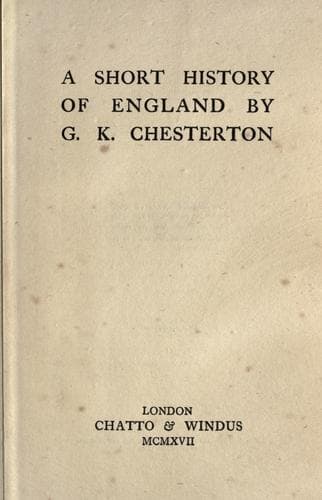
A Short History of EnglandChesterton, G. K. (Gilbert Keith)
History
A Short History of England
Chesterton, G. K. (Gilbert Keith)
Great Britain -- History
It is remarked above that Parliament was now an aristocracy, being an
object of ambition. The truth is, perhaps, more subtle than this; but if
ever men yearn to serve on juries we may probably guess that juries are
no longer popular. Anyhow, this must be kept in mind, as against the
opposite idea of the _jus divinum_ or fixed authority, if we would
appreciate the fall of Richard. If the thing which dethroned him was a
rebellion, it was a rebellion of the parliament, of the thing that had
just proved much more pitiless than he towards a rebellion of the
people. But this is not the main point. The point is that by the removal
of Richard, a step above the parliament became possible for the first
time. The transition was tremendous; the crown became an object of
ambition. That which one could snatch another could snatch from him;
that which the House of Lancaster held merely by force the House of York
could take from it by force. The spell of an undethronable thing seated
out of reach was broken, and for three unhappy generations adventurers
strove and stumbled on a stairway slippery with blood, above which was
something new in the mediaeval imagination; an empty throne.
It is obvious that the insecurity of the Lancastrian usurper, largely
because he was a usurper, is the clue to many things, some of which we
should now call good, some bad, all of which we should probably call
good or bad with the excessive facility with which we dismiss distant
things. It led the Lancastrian House to lean on Parliament, which was
the mixed matter we have already seen. It may have been in some ways
good for the monarchy, to be checked and challenged by an institution
which at least kept something of the old freshness and freedom of
speech. It was almost certainly bad for the parliament, making it yet
more the ally of the mere ambitious noble, of which we shall see much
later. It also led the Lancastrian House to lean on patriotism, which
was perhaps more popular; to make English the tongue of the court for
the first time, and to reopen the French wars with the fine flag-waving
of Agincourt. It led it again to lean on the Church, or rather, perhaps,
on the higher clergy, and that in the least worthy aspect of
clericalism. A certain morbidity which more and more darkened the end of
mediaevalism showed itself in new and more careful cruelties against the
last crop of heresies. A slight knowledge of the philosophy of these
heresies will lend little support to the notion that they were in
themselves prophetic of the Reformation. It is hard to see how anybody
can call Wycliffe a Protestant unless he calls Palagius or Arius a
Protestant; and if John Ball was a Reformer, Latimer was not a Reformer.
But though the new heresies did not even hint at the beginning of
English Protestantism, they did, perhaps, hint at the end of English
Catholicism. Cobham did not light a candle to be handed on to
Nonconformist chapels; but Arundel did light a torch, and put it to his
Public-domain text, read in full here on John Shaqi.
Reviews
Reviews
No reviews yet
Be the first to share your thoughts on this work.
Elsewhere in the archive
Join the Discussion
Join the discussion
Sign in to leave a comment or review.
Sign InorCreate an account