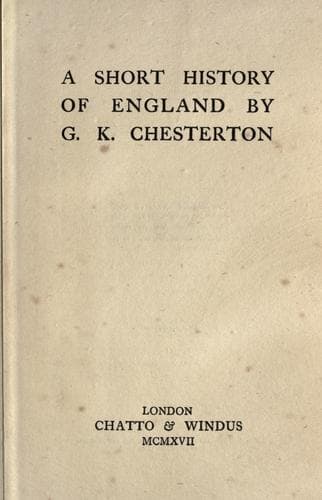
A Short History of EnglandChesterton, G. K. (Gilbert Keith)
History
A Short History of England
Chesterton, G. K. (Gilbert Keith)
Great Britain -- History
The supremacy of the King over the English national church was
not, unfortunately, merely a fad of the King, but became partly, and for
one period, a fad of the church. But apart from all controverted
questions, there is at least a human and historic sense in which the
continuity of our past is broken perilously at this point. Henry not
only cut off England from Europe, but what was even more important, he
cuts off England from England.
The great divorce brought down Wolsey, the mighty minister who had held
the scales between the Empire and the French Monarchy, and made the
modern balance of power in Europe. He is often described under the
dictum of _Ego et Rex Meus_; but he marks a stage in the English story
rather because he suffered for it than because he said it. _Ego et Rex
Meus_ might be the motto of any modern Prime Minister; for we have
forgotten the very fact that the word minister merely means servant.
Wolsey was the last great servant who could be, and was, simply
dismissed; the mark of a monarchy still absolute; the English were
amazed at it in modern Germany, when Bismarck was turned away like a
butler. A more awful act proved the new force was already inhuman; it
struck down the noblest of the Humanists. Thomas More, who seemed
sometimes like an Epicurean under Augustus, died the death of a saint
under Diocletian. He died gloriously jesting; and the death has
naturally drawn out for us rather the sacred savours of his soul; his
tenderness and his trust in the truth of God. But for Humanism it must
have seemed a monstrous sacrifice; it was somehow as if Montaigne were a
martyr. And that is indeed the note; something truly to be called
unnatural had already entered the naturalism of the Renascence; and the
soul of the great Christian rose against it. He pointed to the sun,
saying "I shall be above that fellow" with Franciscan familiarity, which
can love nature because it will not worship her. So he left to his king
the sun, which for so many weary days and years was to go down only on
his wrath.
Public-domain text, read in full here on John Shaqi.
Reviews
Reviews
No reviews yet
Be the first to share your thoughts on this work.
Elsewhere in the archive
Join the Discussion
Join the discussion
Sign in to leave a comment or review.
Sign InorCreate an account