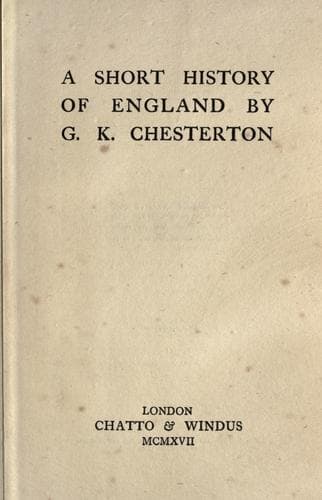
A Short History of EnglandChesterton, G. K. (Gilbert Keith)
History
A Short History of England
Chesterton, G. K. (Gilbert Keith)
Great Britain -- History
To take a modern attack on liberty, on a much lower plane, we are
familiar with the picture of a politician going to the great brewers, or
even the great hotel proprietors, and pointing out the uselessness of a
litter of little public-houses. That is what the Tudor politicians did
first with the monasteries. They went to the heads of the great houses
and proposed the extinction of the small ones. The great monastic lords
did not resist, or, at any rate, did not resist enough; and the sack of
the religious houses began. But if the lord abbots acted for a moment as
lords, that could not excuse them, in the eyes of much greater lords,
for having frequently acted as abbots. A momentary rally to the cause of
the rich did not wipe out the disgrace of a thousand petty interferences
which had told only to the advantage of the poor; and they were soon to
learn that it was no epoch for their easy rule and their careless
hospitality. The great houses, now isolated, were themselves brought
down one by one; and the beggar, whom the monastery had served as a sort
of sacred tavern, came to it at evening and found it a ruin. For a new
and wide philosophy was in the world, which still rules our society. By
this creed most of the mystical virtues of the old monks have simply
been turned into great sins; and the greatest of these is charity.
But the populace which had risen under Richard II. was not yet
disarmed. It was trained in the rude discipline of bow and bill, and
organized into local groups of town and guild and manor. Over half the
counties of England the people rose, and fought one final battle for the
vision of the Middle Ages. The chief tool of the new tyranny, a dirty
fellow named Thomas Cromwell, was specially singled out as the tyrant,
and he was indeed rapidly turning all government into a nightmare. The
popular movement was put down partly by force; and there is the new note
of modern militarism in the fact that it was put down by cynical
professional troops, actually brought in from foreign countries, who
destroyed English religion for hire. But, like the old popular rising,
it was even more put down by fraud. Like the old rising, it was
sufficiently triumphant to force the government to a parley; and the
government had to resort to the simple expedient of calming the people
with promises, and then proceeding to break first the promises and then
the people, after the fashion made familiar to us by the modern
politicians in their attitude towards the great strikes. The revolt bore
the name of the Pilgrimage of Grace, and its programme was practically
the restoration of the old religion. In connection with the fancy about
the fate of England if Tyler had triumphed, it proves, I think, one
thing; that his triumph, while it might or might not have led to
something that could be called a reform, would have rendered quite
impossible everything that we now know as the Reformation.
Public-domain text, read in full here on John Shaqi.
Reviews
Reviews
No reviews yet
Be the first to share your thoughts on this work.
Elsewhere in the archive
Join the Discussion
Join the discussion
Sign in to leave a comment or review.
Sign InorCreate an account