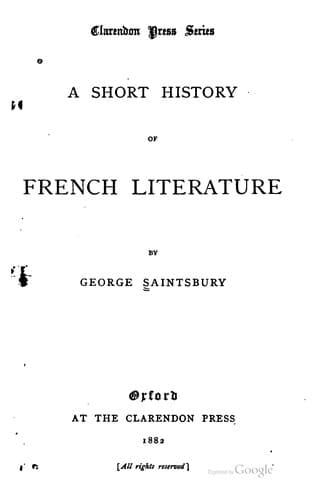
A Short History of French LiteratureSaintsbury, George
History
A Short History of French Literature
Saintsbury, George
French literature -- History and criticism
Sometimes, as in _La Coqueluche_, the author becomes a simple
chronicler describing incidents of his time. Indeed it would hardly be
an exaggeration to describe Gringore's work as the result of a kind of
groping after journalism condemned by the circumstances of the time to
the most awkward and inappropriate form. In his definitely dramatic work
the same practical tendency reappears. The tetralogy is of a directly
politico-social kind. The _cry_, a summons in ironical terms to _sots_
of all kinds to come and hear their lesson; the sotie, an audacious
satire on the state of things; the morality, in which the very names of
the personages--Peuple Francois, Peuple Italique, Divine Pungnicion,
etc.--speak for themselves, all show this tendency; and even the _bonne
bouche_ at the end, the farce (which is altogether too Rabelaisian in
subject for description here), seems to illustrate the motto--a very
practical one--'Il faut cultiver son jardin.' Less directly the same
purpose can be traced in the _Mystere de Monseigneur Saint Loys_. This
is a picture of the ideal patriot king doing judgment and justice, and
serving God by his voyages over sea, and his punishments of blasphemers
and loose livers at home.
[Sidenote: The last Age of the Mediaeval Theatre.]
The first two quarters, and especially the first quarter, of the century
contributed plentifully to the list of mysteries, moralities, and
farces. The dates of the latter are not easy to ascertain, and it is
probable that most of them are older than the present period. The taste
for very lengthy mysteries and moralities, however, had by no means died
out, and some of the mysteries, notably those of Antoine Chevallet, are
of considerable merit. To the sixteenth century too belongs what is
probably the longest of all moralities, that on _The Just and Unjust
Man_, which contains 36,000 lines, besides the _Mundus_, _Caro_, _et
Daemonia_, and the _Condamnation de Banquet_ already described.
Public-domain text, read in full here on John Shaqi.
Reviews
Reviews
No reviews yet
Be the first to share your thoughts on this work.
Elsewhere in the archive
Join the Discussion
Join the discussion
Sign in to leave a comment or review.
Sign InorCreate an account