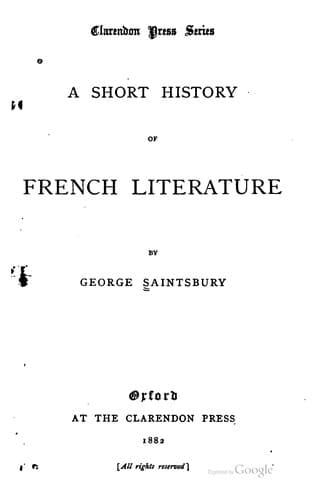
A Short History of French LiteratureSaintsbury, George
History
A Short History of French Literature
Saintsbury, George
French literature -- History and criticism
thing; attempts at history proper as distinct from mere annals and
chronicles have been made. Literature, in short, is organised, and
literary labour works in matter roughly at least prepared and shaped.
One of the greatest drawbacks of mediaeval literature, the confusion of
styles, the handling of science in verse, of theology in terms taken
from amatory romances, of politics in 'dreams,' of social satire in
clumsy allegories, is cleared away. The form most suitable for every
kind of literary work has been more or less made clear to the literary
workman, and a plentiful supply of material in the shape of vocabulary
is at his disposal.
That this great accomplishment is on the whole the doing of the Pleiade
in its larger sense, as designating and including the men of letters of
1550-1600, no impartial student of the period can doubt. But at the same
time there is no doubt either that their work was both incomplete and in
some respects open to grave objection. They had, like all reformers,
literary as well as political, neglected to preserve the historical
continuity, and deliberately turned their backs on the traditions of the
language and the literature. Their importations and imitations had been
sometimes unnecessary, sometimes awkward, sometimes absurd. The mass of
their contributions required examination, arrangement, and no doubt in
some cases rejection. Moreover, they had on the whole concentrated their
attention too much upon poetry; prose, the less exquisite but the more
useful instrument, had been comparatively neglected. Almost all styles
had been tried in it, but no general style nor the conditions of any had
been elaborated. In drama much remained to be done. The model was there
in the rough, but the workmen had been unskilful, and fifty years of
practice on the plan of Jodelle had not yet resulted in the composition
of one really dramatic play. In short, though the Pleiade movement had
begun by being nothing if not critical, it had not kept up the habit of
self-criticism. The application of this criticism was what was left for
the seventeenth century to supply, and at the same time the elaboration
of a complete and workman-like prose style. We shall see how early and
how eagerly this task was accepted, and how thoroughly it was carried
out; so thoroughly, that the seventeenth century is the age of perfect
French prose. But what was gained in prose was lost in poetry, and,
putting the dramatists aside, the drop in this respect from the
sixteenth to the seventeenth century is immense. The sixteenth is,
putting our own days out of question, the palmy time of poetry in
France. The urbanity of Marot, the stately grace of Ronsard and his
followers, the majesty of Du Bartas, the fire of D'Aubigne, the nervous
and yet effortless strength of Regnier, have never been surpassed, and
until the last half century they have rarely been equalled. If to this
be added the more irregular and unequal, but hardly inferior merits of
Public-domain text, read in full here on John Shaqi.
Reviews
Reviews
No reviews yet
Be the first to share your thoughts on this work.
Elsewhere in the archive
Join the Discussion
Join the discussion
Sign in to leave a comment or review.
Sign InorCreate an account