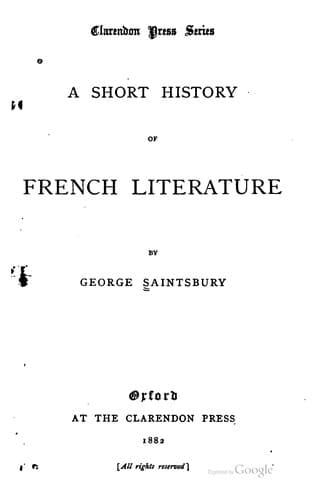
A Short History of French LiteratureSaintsbury, George
History
A Short History of French Literature
Saintsbury, George
French literature -- History and criticism
French literature to give the type only without differentiation. An
ill-natured critic constantly feels inclined to alter the lists of
Racine's dramatis personae, and instead of the proper names to
substitute 'a lover,' 'a mother,' 'a tyrant,' and so forth. So great an
artist and so careful a worker as Racine could not, of course, escape
giving some individuality to his creations. Hermione, Phedre, Achille,
Berenice, Athalie, are all individual enough of their class. But the
class is the class of types rather than of individuals. After long
debate this difference has been admitted by most reasonable French
critics, and they now confine themselves to the argument that the two
processes, the illustration of the universal by means of the particular,
and the indication of the particular by means of the universal, are
processes equally legitimate and equally important. The difficulty
remains that, by common consent of mankind--Frenchmen not
excluded--Hamlet, Othello, Falstaff, Rosalind, are fictitious persons
far more interesting to their fellow-creatures who are not fictitious
than any personages of the French stage. There is, moreover, a simple
test which can be applied. No one can doubt that, if Shakespeare had
chosen to adopt the style, and had accepted the censorship of a Boileau,
he could easily have written _Phedre_. It would be a bold man who should
say that Racine could, with altered circumstances but unaltered powers,
have written _Othello_.
[Sidenote: Minor Tragedians.]
Public-domain text, read in full here on John Shaqi.
Reviews
Reviews
No reviews yet
Be the first to share your thoughts on this work.
Elsewhere in the archive
Join the Discussion
Join the discussion
Sign in to leave a comment or review.
Sign InorCreate an account