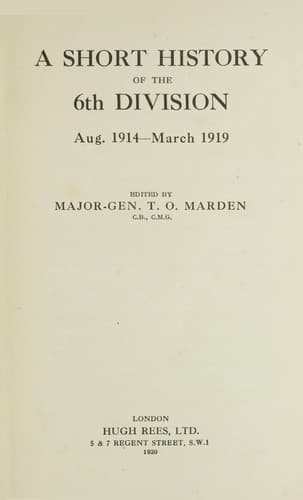
A Short History of the 6th Division: Aug. 1914-March 1919
History
A Short History of the 6th Division: Aug. 1914-March 1919
Great Britain. Army. Division, 6th; World War, 1914-1918 -- Campaigns -- Western Front; World War, 1914-1918 -- Regimental histories -- Great Britain
The successes of other Divisions in the south of the British zone had
been constant and fairly easy for some time, so that the partial
success which the Division had obtained was very disappointing to all
ranks. They were much cheered, therefore, to get the following wire
from the Army Commander (General Sir H. Rawlinson):--"Please convey to
the 6th Division my congratulations and warm thanks for their success
of yesterday. Though all objectives were not attained they carried
through a difficult operation with great gallantry and determination.
I offer to all ranks my warm thanks and congratulations."
All units had heavy fighting, in which some had incurred considerable
losses, and all were tired and in want of reorganization. It was
therefore decided not to renew the attack for a few days, and to
devote the interval to a proper artillery preparation (the heavy
artillery put 1,000 shells on the Quadrilateral in one day), the
reorganization of battalions, and the construction of a jumping-off
position, in the execution of which the R.E. (Lt.-Col. H. A. L. Hall)
and the Pioneers rendered invaluable assistance. The fighting up to
this date had yielded 6 officers and 264 other ranks prisoners, and 65
machine-guns.
On the morning of the 24th September a fresh attack was launched; the
18th Infantry Brigade, to which was attached the 1st Leicestershire
Regiment, attacking on the right; the 16th Infantry Brigade on the
left. The French 36th Corps attacked with a fresh division
simultaneously to our right; the 1st Division, which had taken over
the task of the capture of Fresnoy and Gricourt, on our left. The four
tanks detailed to attack the Quadrilateral again had bad luck, one
being turned absolutely turtle by a mine field. The three battalions
of the 18th Infantry Brigade met at first with little success, the
11th Essex on the left establishing a rather precarious footing
in one face of the Quadrilateral, and the 1st West Yorkshire Regiment
getting in at one point in Douai Trench, running south from the Strong
Point. The D.L.I., attacking south of them through Holnon Village,
could make no headway. The French had during the morning captured
Round Hill and part of Manchester Hill, and came up in line with us.
The 16th Infantry Brigade fared much better, and working down from the
north was able in the course of the day to secure the northern face of
the Quadrilateral. Their four tanks were of great assistance to them
this day. Throughout the day the 18th Infantry Brigade maintained the
fight with characteristic determination, but without improving its
position very much. At 11 p.m., however, it launched the 1st
Leicestershire Regiment by moonlight in a further attack on Douai
Trench. The attack, delivered with great gallantry, was successful,
and many enemy were killed in the trench which was found to be
strongly held. In spite of the very rough handling which it had
received on the 24th the 18th Infantry Brigade stuck grimly to its
Public-domain text, read in full here on John Shaqi.
Reviews
Reviews
No reviews yet
Be the first to share your thoughts on this work.
Join the Discussion
Join the discussion
Sign in to leave a comment or review.
Sign InorCreate an account