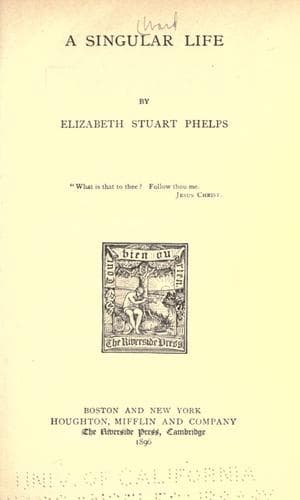
Christian life -- Fiction; Clergy -- Fiction; Love stories; Missions -- Fiction; New England -- Fiction; Temperance -- Fiction
I dare not believe--I dare not hope, that what I have done can
mean any more to _you_ than passing embarrassment to a friendship
whose value and permanence shall not be disturbed by my weakness
if I can help it.
I love you. I ought not to have told you so. I did not mean to
tell you so.
But I love you! A man situated as I am has no right to declare
his feeling for a woman like yourself. This wrong have I
done--not to you; I do not presume to dream that I could thereby
in any way wrong _you_--but to myself, and to my love for you. It
was my sacred secret; it is now your absolute possession. Do with
it--and with me--as you will.
EMANUEL BAYARD.
He dispatched this note by the first mail to Campo Bello, and
waited in such patience as he could command for such answer as she
chose to make him. He waited a miserable time. At the end of that
week came a letter in her strong, clear hand. He shut himself into
his rooms, turned the key, and read:--
MY DEAR MR. BAYARD:--I am not quite sure that I entirely
understand you. But I believe in you, altogether; and what I do
not understand, I am proud to take on trust.
The love of a man like yourself would be a tribute to any woman.
I shall count it the honor of my life that you have given it to
me. And I shall be, because of it, all the more and always,
Your loyal friend,
HELEN CARRUTH.
This composed and womanly reply did not serve to quell the
agitation in which Bayard had awaited it. He read and re-read,
studied and scrutinized the few self-contained words with a sense
of helplessness which equaled his misery. His position seemed
to him intolerable. Something undignified about it cut the proud
fellow to the quick. He had thought himself prepared for any
natural phase in the lot which he had elected. In the old language
which the devotees of ages have instinctively used, and which to
each solitary heart seems a figure of speech as new as its own
anguish, Bayard had believed himself able to “bear his cross.” He
had now to learn that, in the curious, complex interplay of human
life, a man may not be able even to wear his burden alone, and drop
decently under it when the time comes. Suppose, as the cross-bearer
crawls along in blood and dust, that the arm of the coarse wood
strikes and bruises the delicate flesh of a woman’s shoulder?
Suppose--oh, suppose the unsupposable, the maddening!
Suppose she might have been led, taught by his great love to love
him? What then?
Because a man had a duty to God, had he none to a woman?
After a night of sleepless misery, he wrote again:--
Is there no way in which I can see you--if only for a moment?
Shall you be in Boston--if you are not coming to Windover--on
your return home? This is more than I can bear.
Yours utterly,
E. B.
Public-domain text, read in full here on John Shaqi.
Reviews
Reviews
No reviews yet
Be the first to share your thoughts on this work.
Elsewhere in the archive
Join the Discussion
Join the discussion
Sign in to leave a comment or review.
Sign InorCreate an account