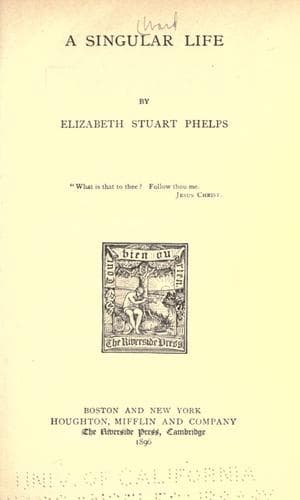
Christian life -- Fiction; Clergy -- Fiction; Love stories; Missions -- Fiction; New England -- Fiction; Temperance -- Fiction
“I don’t suppose,” she faltered, “you’d be willing to be told.
But mother and me have done for him so long--he ain’t well, the
minister ain’t--there’s ways he likes his tea made, and we het the
bricks, come cold weather, for him--and--all those little things.
We’ve tried to take good care of Mr. Bayard! It’s been a good many
years!” said Jane piteously. It was more dreadful to her to give up
boarding the minister, than it was that he should marry the summer
lady in the gold and purple gowns.
“I suppose you and he will go somewhere?” she added bitterly.
“We shan’t forget you, Jane,” said Helen gently.
The calico blouse shoulder shook off the delicate hand that rested
upon it.
“I won’t come in,” she said. “I’ll go right home.”
Jane turned away, and walked across the cliffs. The hotel lights
fell short of her, and the darkness swallowed her undersized,
pathetic figure, as the mystery of life draws down the weak, the
uncomely, and the unloved.
Jane went home, and unlocked her bureau drawer. From beneath the
sachet-bag, on which her little pile of six handkerchiefs rested
precisely, she drew out an old copy of Coleridge. The book was
scented with the sachet, and had a sickly perfume; it was incense
to Jane. She turned the leaves to find “Alph, the sacred river;”
then shut the book, and put it back in the bureau drawer. She did
not touch it with her lips or cheek. She handled it more tenderly
than she did her Bible.
* * * * *
Left to herself, Helen felt the full force of the situation
fall upon her, in a turmoil of fear and perplexity. The whole
thing was so foreign to her nature and to the experience of her
protected life, that it seemed to her more than incredible. There
were moments when she was in danger of underrating the facts,
and letting the chances take their course--it seemed to her so
impossible that Jane and Lena should not, somehow, be mistaken.
Her mind was in a whirlwind of doubt and dismay. With a certain
coolness in emergencies characteristic of her, she tried to think
the position out, by herself. This futile process occupied perhaps
a couple of hours.
It was between eleven and twelve o’clock when the Professor, with
a start, laid down his manuscript upon the Revised Version. For
the door of the clam study had opened quietly, and revealed his
daughter’s agitated face.
“Papa,” she said, “I am in a great trouble. I have come to you
first--to know what to do--before I go to him. I’ve been thinking,”
she added,“that perhaps this is one of the things that fathers are
_for_.”
Like a little girl she dropped at his knee, and told him the whole
story.
“I couldn’t go to a man, and ask him to marry me, without letting
you know, Papa!” said the Professor’s daughter.
Public-domain text, read in full here on John Shaqi.
Reviews
Reviews
No reviews yet
Be the first to share your thoughts on this work.
Elsewhere in the archive
Join the Discussion
Join the discussion
Sign in to leave a comment or review.
Sign InorCreate an account