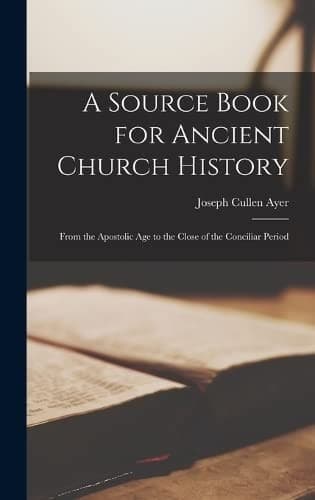
A Source Book for Ancient Church HistoryAyer, Joseph Cullen
History
A Source Book for Ancient Church History
Ayer, Joseph Cullen
Church history -- Primitive and early church, ca. 30-600 -- Sources
Christianity was regarded as a revealed philosophy by the apologists. This
they considered under three principal aspects: knowledge, or a revelation
of the divine nature; a new law, or a code of morals given by Christ; and
life, or future rewards for the observance of the new law that had been
given. The foundation of all was laid in the doctrine of the Logos (_A_),
which involved, as a consequence, some theory of the relation of the
resulting distinctions in the divine nature to the primary conviction of
the unity of God, or some doctrine of the Trinity (_B_). As a result of
the new law given, moralism was inevitable, whereby a man by his efforts
earned everlasting life (_C_). The proof that Jesus was the incarnate
Logos was drawn from the fulfilment of Hebrew prophecy (_D_). It should be
remembered that the apologists influenced later theology by their actual
writings, and not by unexpressed and undeveloped opinions which they held
as a part of the common tradition and the Christianity of the Gentile
Church. Whatever they might have held in addition to their primary
contentions had little or no effect, however valuable it may be for modern
students, and the conviction that Christianity was essentially a revealed
philosophy became current, especially in the East, finding its most
powerful expression in the Alexandrian school. (_V. infra_, § 43.)
(A) The Logos Doctrine
As stated by the apologists, the Logos doctrine not only furnished a
valuable line of defence for Christianity (_v. supra_, § 20), but also
gave theologians a useful formula for stating the relation of the divine
element in Christ to God. That divine element was the Divine Word or
Reason (Logos). It is characteristic of the doctrine of the Logos as held
by the early apologists that, although they make the Word, or Logos,
personal and distinguish Him from God the Father, yet that Word does not
become personally distinguished from the source of His being until, and in
connection with, the creation of the world. Hence there arose the
distinction between the _Logos endiathetos_, or as yet within the being of
the Father, and the _Logos prophorikos_, or as proceeding forth and
becoming a distinct person. Here is, at any rate, a marked advance upon
the speculation of Philo, by whom the Logos is not regarded as distinctly
personal.
(_a_) Justin Martyr, _Apol._, I, 46. (MSG, 6:398.)
In addition to the following passage from Justin Martyr, see
above, § 20, for a longer statement to much the same effect.
Public-domain text, read in full here on John Shaqi.
Reviews
Reviews
No reviews yet
Be the first to share your thoughts on this work.
Elsewhere in the archive
Join the Discussion
Join the discussion
Sign in to leave a comment or review.
Sign InorCreate an account