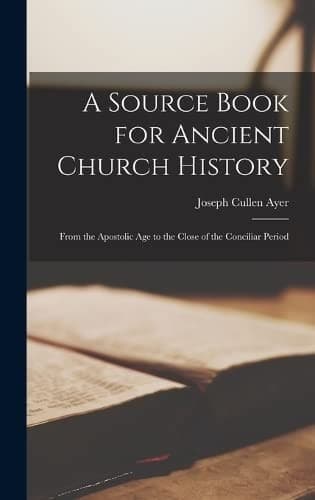
A Source Book for Ancient Church HistoryAyer, Joseph Cullen
History
A Source Book for Ancient Church History
Ayer, Joseph Cullen
Church history -- Primitive and early church, ca. 30-600 -- Sources
How can they say that the flesh which is nourished with the body of the
Lord and with His blood goes to corruption and does not partake of life?
Let them, therefore, either alter their opinion or cease from offering the
things mentioned. But our opinion is in accordance with the eucharist, and
the eucharist, in turn, establishes our opinion. For we offer to Him His
own, announcing consistently the fellowship and union of the flesh and the
Spirit. For as the bread which is produced from the earth when it receives
the invocation of God is no longer common bread, but the eucharist,
consisting of two realities, earthly and heavenly, so, also, our bodies,
when they receive the eucharist, are no longer corruptible, having the
hope of the resurrection unto eternity.
Period IV. The Age Of The Consolidation Of The Church: 200 to 324 A. D.
In the fourth period of the Church under the heathen Empire, or the period
of the consolidation of the Church, the number of Christians increased so
rapidly that the relation of the Roman State to the Church became a matter
of the gravest importance (ch. 1). During a period of comparative peace
and prosperity the Church developed its doctrinal system and its
constitution (ch. 2). Although the school of Asia Minor became isolated
and temporarily ceased to affect the bulk of the Church elsewhere, the
school of the apologists was brilliantly continued at Alexandria under
Clement and Origen, and later under Origen at Cæsarea in Palestine.
Meanwhile the foundations were laid in North Africa for a distinctive type
of Western theology, inaugurated by Tertullian and developed by Cyprian.
After years of alternating favor and local persecutions, the first general
persecution (ch. 3) broke upon the Church, rudely testing its organization
and ultimately strengthening and furthering its tendencies toward a
strictly hierarchical constitution. In the long period of peace that
followed (ch. 4), the discussions that had arisen within the Church as to
the relation of the divine unity to the divinity of Christ reached a
temporary conclusion, the cultus was elaborated and assumed the essentials
of its permanent form, and the episcopate was made supreme over rival
authorities within the Church, becoming at once the expression and organ
of ecclesiastical unity. At the same time new problems arose; within the
Church there was the appearance of an organized asceticism which appeared
for a time to be a rival to the Church’s system, and outside the Church
the appearance of a hostile rival in the rapidly spreading Manichæan
system, in which was revived, in a better organized and therefore more
dangerous form, the expelled Gnosticism. The period ends with the last
general persecution (ch. 5).
Chapter I. The Political And Religious Conditions Of The Empire
Public-domain text, read in full here on John Shaqi.
Reviews
Reviews
No reviews yet
Be the first to share your thoughts on this work.
Elsewhere in the archive
Join the Discussion
Join the discussion
Sign in to leave a comment or review.
Sign InorCreate an account