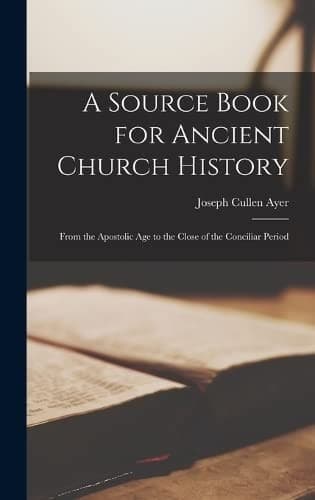
A Source Book for Ancient Church HistoryAyer, Joseph Cullen
History
A Source Book for Ancient Church History
Ayer, Joseph Cullen
Church history -- Primitive and early church, ca. 30-600 -- Sources
before was regarded as holy was a most wicked spirit. But that woman, who
previously, by the wiles and deceits of the demon, was attempting many
things for the deception of the faithful, had among other things by which
she deceived many also frequently dared this—to pretend that with an
invocation, not to be contemned, she sanctified bread and consecrated the
eucharist and offered sacrifice to the Lord without the sacrament as
customarily uttered; and to have baptized many, making use of the usual
and lawful words of interrogation, that nothing might seem to be different
from the ecclesiastical and lawful mode.
(_e_) Eusebius, _Hist. Ec._, VI, 34. (MSG, 20:595.) Preuschen, _Analecta_,
I, § 15, and Kirch, n. 397.
The following tradition that Philip the Arabian was a Christian is
commonly regarded as doubtful. That he favored the Christians, and
even protected them, may be the basis for such a report.
When Gordianus (238-244) had been Roman Emperor for six years, Philip
(244-249) succeeded him. It is reported that he, being a Christian,
desired on the day of the last paschal vigil to share with the multitude
in the prayers of the Church, but was not permitted by him who then
presided to enter until he had made confession and numbered himself among
those who were reckoned as transgressors and who occupied the place of
penitence. For if he had not done this, he would never have been received
by him, on account of the many crimes he had committed, and it is said
that he obeyed readily, manifesting in his conduct a genuine and pious
fear of God.
§ 37. The Extension of the Church at the Middle of the Third Century
Some approximately correct idea of the extension of the Church by the
middle of the third century may be gathered from a precise statement of
the organization of the largest church, that at Rome, about the year 250
(_a_), from the size of provincial synods, of which we have detailed
statements for North Africa (_b_), from references to organized and
apparently numerous churches in various places not mentioned in earlier
documents (_c_). That the Church, at least in Egypt and parts adjacent,
had ceased to be confined chiefly to the cities and that it was composed
of persons of all social ranks is attested by Origen (_d_).
(_a_) Cornelius, _Ep. ad Fabium_, in Eusebius, _Hist. Ec._, VI, 43. (MSG,
20:622.) _Cf._ Kirch, n. 222 _ff._
Cornelius was bishop of Rome 251-253.
Public-domain text, read in full here on John Shaqi.
Reviews
Reviews
No reviews yet
Be the first to share your thoughts on this work.
Elsewhere in the archive
Join the Discussion
Join the discussion
Sign in to leave a comment or review.
Sign InorCreate an account