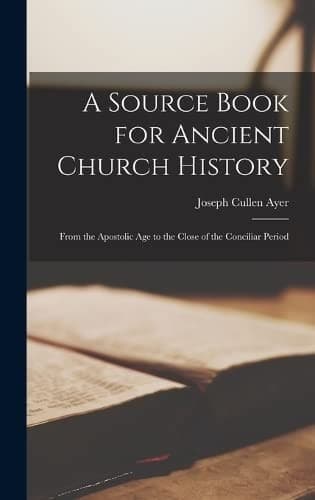
A Source Book for Ancient Church HistoryAyer, Joseph Cullen
History
A Source Book for Ancient Church History
Ayer, Joseph Cullen
Church history -- Primitive and early church, ca. 30-600 -- Sources
The Church grew up with only a loose form of organization. Each local
congregation was for a while autonomous, and it was the local constitution
that first took a definite and fixed form. In the first centuries local
customs naturally varied, and conflicts were sure to arise when various
hitherto isolated churches came into closer contact and the sense of
solidarity deepened. The first clash of opposing customs occurred over the
date of Easter, as to which marked differences existed between the
churches of Asia Minor, at that time the most flourishing part of the
Church, and the churches of the West, especially with the church of Rome,
the strongest local church of all. The course of the controversy is
sufficiently stated in the following selection from Eusebius. The outcome
was the practical isolation of the churches of Asia Minor for many years.
The controversy was not settled, and the churches of Asia Minor did not
again play a prominent part in the Church until the time of Constantine
and the Council of Nicæa, 325 (see § 62, _b_), although a provisional
adjustment of the difficulty, so far as the West was concerned, took place
shortly before, at the Council of Arles (see § 62, _a_, 2).
Eusebius, _Hist. Ec._, V, 23, 24. (MSG, 20:489.) Mirbt, n. 22, and in
Kirch, n. 78 _ff._
A brief extract from the following may be found above in § 3 in a
somewhat different connection.
Ch. 23. At this time a question of no small importance arose. For the
parishes [_i.e._, dioceses in the later sense of that word] of all Asia,
as from an older tradition, held that the fourteenth day of the moon,
being the day on which the Jews were commanded to sacrifice the lamb,
should be observed as the feast of the Saviour’s passover, and that it was
necessary, therefore, to end their fast on that day, on whatever day of
the week it might happen to fall. It was not, however, the custom of the
churches elsewhere to end it at this time, but they observed the practice,
which from apostolic tradition has prevailed to the present time, of
ending the fast on no other day than that of the resurrection of the
Saviour. Synods and assemblies of bishops were held on this account, and
all with one consent, by means of letters addressed to all, drew up an
ecclesiastical decree that the mystery of the resurrection of the Lord
from the dead should be celebrated on no other day than on the Lord’s Day,
and that we should observe the close of the paschal fast on that day only.
There is still extant a writing of those who were then assembled in
Palestine, over whom Theophilus, bishop of the parish of Cæsarea, and
Narcissus, Bishop of Jerusalem, presided; also another of those who were
likewise assembled at Rome, on account of the same question, which bears
the name of Victor; also of the bishops in Pontus, over whom Palmas, as
the oldest, presided; and of the parishes in Gaul, of which Irenæus was
bishop; and of those in Osrhoene and the cities there; and a personal
Public-domain text, read in full here on John Shaqi.
Reviews
Reviews
No reviews yet
Be the first to share your thoughts on this work.
Elsewhere in the archive
Join the Discussion
Join the discussion
Sign in to leave a comment or review.
Sign InorCreate an account